
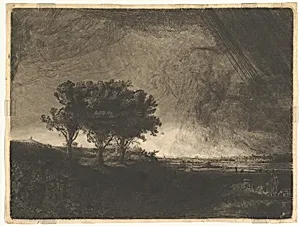
The Three Trees, after Rembrandt
Medium
Etching with plate tone; third state of six
Dimensions
plate: 8 1/4 x 11 in. (21 x 28 cm) sheet: 8 7/16 x 11 1/4 in. (21.5 x 28.5 cm)
Classification
Prints
Department
Drawings and Prints
Museum
Metropolitan Museum of Art, New York, NY
Credit
Gift of Bonnie and Manuel Schonhorn, 2011
Accession Number
2011.521.2
Rights
Public Domain
Tags
Art Historical Context
In the serene landscape of *The Three Trees, after Rembrandt*, Captain William E. Baillie the dramatic essence of Rembrandt van Rijn's iconic1643 etching. Created in 1758, this print depicts a windswept sky looming over three solitary trees, evoking nature's raw power and solitude. Baillie, a British military officer and skilled engraver, faithfully reproduced the Dutch master's composition as a tribute, demonstrating the enduring appeal of Rembrandt's landscapes in the 18th. Rendered in etching with plate tone—the third state of six—this work showcases innovative printmaking techniques. Etching involves biting lines into a metal plate with acid, while plate tone adds subtle, smoky gradations by selectively wiping ink from the surface, mimicking Rembrandt's masterful use of light and shadow to create atmospheric depth. At 8¼ × 11 inches, the plate size invites intimate contemplation of the textured foliage and turbulent clouds. Housed in the Metropolitan Museum of Art's Drawings and Prints department (gift of Bonnie and Manuel Schonhorn, 2011), this print highlights Rembrandt's influence on later artists and the cultural value of reproductive works, which made old master visions accessible to wider audiences during the Enlightenment era. A testament to timeless natural beauty, it reminds us of etching's power to freeze fleeting moments.
About the Artist
Captain William E. Baillie|Rembrandt (Rembrandt van Rijn) (Irish|Italian) · 1723 |1615 –1810 |1673
Irish, Kilbride, County Carlow 1723–1810 London|Italian, Arenella (Naples) 1615–1673 Rome