
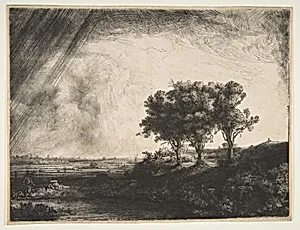
The Three Trees
Medium
Etching, engraving and drypoint
Dimensions
plate: 8 3/8 x 10 15/16 in. (21.3 x 27.8 cm) sheet: 8 3/8 x 11 1/8 in. (21.3 x 28.3 cm) mount: 14 1/4 x 19 1/4 in. (36.2 x 48.9 cm)
Classification
Prints
Department
Drawings and Prints
Museum
Metropolitan Museum of Art, New York, NY
Credit
H. O. Havemeyer Collection, Bequest of Mrs. H. O. Havemeyer, 1929
Accession Number
29.107.31
Rights
Public Domain
Tags
Art Historical Context
Rembrandt van Rijn's *The Three Trees* (1643) stands as a pinnacle of Dutch Golden Age printmaking, the stark beauty of the flat Dutch landscape. This etching engraving, and drypoint on a modest plate measuring 8 3/8 x 10 15/16 inches showcases three silhouetted trees dominating a windswept plain under a turbulent sky. As one of Rembrandt's rare pure landscapes—devoid of human figures—it evokes the sublime power of nature, a theme resonant in 17th-century Netherlands amid rapid urbanization and reclamation of land from the sea. Rembrandt's mastery of mixed techniques shines here: etching for fluid lines, engraving for precision, and drypoint for the rich, velvety burr that mimics his oil paintings' textures and dramatic chiaroscuro. Printed in a single known state, this work highlights his innovative approach to printmaking, pushing the medium toward painterly depth. Created during his Amsterdam maturity, it reflects Baroque interests in light and atmosphere, transforming a simple scene into a meditation on transience. Housed in the Metropolitan Museum of Art's Drawings and Prints department as part of the prestigious H. O. Havemeyer Collection (1929), *The Three Trees* remains a testament to Rembrandt's versatility beyond portraits and biblical scenes, inviting visitors to ponder the enduring allure of humble trees against an endless horizon.
About the Artist
Rembrandt (Rembrandt van Rijn) · 1606–1669
Rembrandt Harmenszoon van Rijn (1606–1669) stands as one of the greatest visual artists in the history of Western art and the most important Dutch painter of the 17th century. Born in Leiden to a prosperous miller's family, Rembrandt transformed painting through his revolutionary use of light and shadow, his psychological depth in portraiture, and his elevation of etching to a fine art. His approx...