
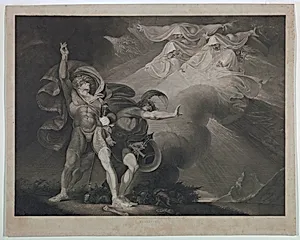
The Three Witches Appearing to Macbeth
Classification
Department
Smithsonian Collection
Museum
Smithsonian American Art Museum
Credit
Smithsonian American Art Museum
Accession Number
1957-41-219
Rights
Public Domain
About this artwork
Research in Progress
Art Historical Context
In the haunting print *The Three Witches Appe to Macbeth*, British artist John Trotter captures a pivotal supernatural moment from William Shakespeare's timeless tragedy *Macbeth*. Created in 1790, during the late 18th century when Shakespearean drama gripped British theaters and popular culture, the work depicts the eerie encounter between Macbeth, his companion Banquo, and the witches on a desolate heath. Trotter, active from 1756 to 1792, was known for his theatrical prints that brought dramatic scenes to life for a wide audience. As a print from the Smithsonian American Art Museum's collection, this piece exemplifies the era's booming printmaking industry, which made high-culture literature accessible beyond elite patrons. Prints like Trotter's were affordable reproductions, often sold at theaters or markets, fueling public fascination with Shakespeare's exploration of ambition, fate, and the occult. Though the specific medium remains under research, such works typically employed techniques like etching or engraving to convey atmospheric drama through shadowy figures and misty landscapes. This artwork invites visitors to ponder the witches' seductive prophecies—"All hail, Macbeth, that shalt be king hereafter!"—that propel the play's tragic arc. Housed in an American institution, it bridges British literary heritage with transatlantic artistic exchange, reminding us of Shakespeare's enduring global spell.