
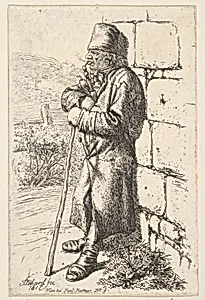
The Tobacco Smoker
Medium
Etching; third state
Dimensions
sheet: 4 3/16 x 2 3/4 in.
Classification
Prints
Department
Drawings and Prints
Museum
Metropolitan Museum of Art, New York, NY
Credit
The Elisha Whittelsey Collection, The Elisha Whittelsey Fund, 1949
Accession Number
49.36.7
Rights
Public Domain
Tags
Art Historical Context
In the intimate world of early 19th-century print, *The Tobacco Smoker*1817) captures a quiet moment of everyday indulgence. This etching, created collaboratively by German artists Johann Christoph Erhard and Kettner, depicts a man immersed in the ritual of tobacco smoking—a common motif in genre scenes of the era. Measuring just 4 3/16 x 2 3/4 inches, its diminutive scale invites close viewing, perfect for personal collections or albums. Etching in its third state reveals the artists' meticulous process: the copper plate was reworked multiple times to refine lines, tones, and details, showcasing Erhard's renowned skill in miniature reproductive prints. Tobacco, introduced to Europe centuries earlier, had by 1817 become a cultural staple, symbolizing leisure, contemplation, or even social status in Biedermeier-era imagery. This work reflects that fascination, blending technical precision with relatable human activity. Housed in the Metropolitan Museum of Art's Drawings and Prints department as part of The Elisha Whittelsey Collection (1949), *The Tobacco Smoker* exemplifies how prints democratized art, making detailed vignettes accessible beyond oil paintings. A charming glimpse into Regency-era habits, it reminds us how simple pleasures endure in artistic memory.
About the Artist
Johann Christoph Erhard|Ferdinand Kettner · 1795–1822
Johann Christoph Erhard (1795–1822) was a German painter and etcher of the Romantic era whose sensitive landscape studies and skillful prints earned him a growing reputation before his tragically early death at twenty-six. Born in Nuremberg, he studied at the Nuremberg Academy and later in Munich, where he was influenced by the Romantic landscape tradition and the revival of interest in the art of...