
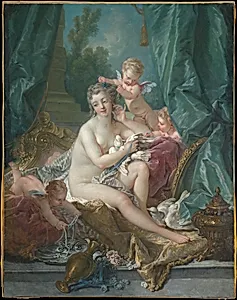
The Toilette of Venus
1751
Medium
Oil on canvas
Dimensions
42 5/8 x 33 1/2 in. (108.3 x 85.1 cm)
Classification
Paintings
Department
European Paintings
Museum
Metropolitan Museum of Art, New York, NY
Credit
Bequest of William K. Vanderbilt, 1920
Accession Number
20.155.9
Rights
Public Domain
Tags
Art Historical Context
François Boucher's *The Toilette of Venus (1751) is a quintessential Rococo masterpiece, capturing the goddess of love in an intimate moment of grooming surrounded by playful cupids. Painted in oil on canvas, this 42 5/8 x 33 1/2-inch work exemplifies Boucher's signature style—lush, voluptuous forms bathed in soft, glowing light and delicate pastel hues. As the favored artist of Madame de Pompad, mistress to Louis XV, Boucher his mythological scenes with the opulent sensuality of 18th-century French court life, blending eroticism with whimsy. The painting's focus on Venus's nude form highlights the Rococo era's celebration of beauty, femininity, and pleasure, departing from the grandeur of Baroque art toward lighter, more intimate expressions. Boucher's fluid brushwork and intricate details, from the goddess's radiant skin to the cherubs' mischievous energy, showcase his technical virtuosity in rendering silk textures and ethereal atmospheres. This theme of Venus at her toilette was popular in the period, symbolizing idealized femininity and luxury. Today, it graces the Metropolitan Museum of Art's European Paintings department, a bequest from William K. Vanderbilt in 1920. Visitors are drawn to its timeless allure, inviting reflection on how art once mirrored aristocratic fantasies of divine elegance.
About the Artist
François Boucher · 1703–1770
François Boucher (1703–1770) stands as the quintessential master of French Rococo painting and the most celebrated decorative artist of the 18th century. Born in Paris to a lace designer, Boucher created a visual language that perfectly embodied the refined taste, sensuality, and elegance of Louis XV's court. His prolific output—encompassing paintings, tapestry designs, theatrical sets, and decora...