
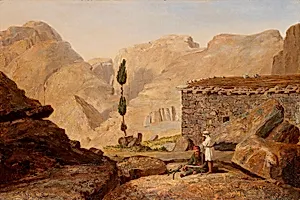
The Top of Mount Sinai with the Chapel of Elijah
after 1844
Medium
Painting
Classification
Painting
Department
Smithsonian Collection
Museum
Smithsonian American Art Museum
Credit
Smithsonian American Art Museum, Museum purchase
Accession Number
1991.2
Rights
Public Domain
Tags
About this artwork
Miner Kilbourne Kellogg painted several pictures of Mount Sinai and was fascinated by its religious significance as the place where Moses received the Ten Commandments. This painting shows the artist himself, seated on the summit next to the Chapel of Elijah. Through his studies of the area, Kellogg found evidence of a valley called Es-Seba’îyeh, where Moses and the Israelites may have camped. Back in America, he gave many lectures about his travels, using this painting along with others to illu...
Art Historical Context
The painting a stark, sunlit summit of Mount Sinai, where massive tan and brown boulders dominate the foreground and frame a modest stone chapel with a tiled roof on the right. A man in a red cap sits on the rocky ground, absorbed in a sketchbook or map, while a second figure in white stands nearby. A single slender tree rises in the middle distance against a backdrop of pale, eroded mountains that recede into a hazy sky, all rendered with careful attention to the dry textures of stone and earth. Miner Kilbourne Kellogg produced this work after 1844, drawing on his own travels through the Sinai Peninsula. The seated figure is the artist himself, positioned beside the Chapel of Elijah at the mountain’s summit. Kellogg was deeply interested in the site’s biblical associations, particularly its connection to Moses and the Ten Commandments, and he identified a nearby valley he believed could have served as a campsite for the Israelites. Back in the United States, Kellogg frequently lectured on his findings and used paintings such as this one to illustrate them for audiences. The work now belongs to the Smithsonian American Art Museum.