
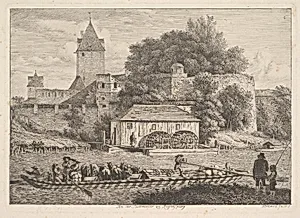
The Town Wall of Regensberg
Medium
Etching; fourth state
Dimensions
Plate: 4 15/16 × 7 in. (12.5 × 17.8 cm) Sheet: 8 5/16 × 10 1/2 in. (21.1 × 26.7 cm)
Classification
Prints
Department
Drawings and Prints
Museum
Metropolitan Museum of Art, New York, NY
Credit
The Elisha Whittelsey Collection, The Elisha Whittelsey Fund, 1949
Accession Number
49.21.1
Rights
Public Domain
Tags
Art Historical Context
Johann Christoph Erhard’s *The Town Wall of Regensberg* (1817) captures a serene riverside view of the medieval fortifications surrounding the Swiss town. Rendered as an etching in its fourth state, the print delicately balances architectural detail with the gentle flow of the river, where boats and watermills animate the scene. The compact plate size invites close inspection, revealing Erhard’s precise linework that conveys both the sturdy stone walls and the reflective water below. Created in the early nineteenth century, this work reflects the Romantic era’s fascination with historic European towns and their picturesque settings. Etching, a medium prized for its ability to produce multiple impressions while preserving fine textures, allowed artists like Erhard to share such intimate landscapes widely. The fourth state indicates the artist’s careful revisions, refining light and shadow to heighten the tranquil yet evocative mood. Acquired by the Metropolitan Museum of Art through the Elisha Whittelsey Collection, the print exemplifies early 19th-century German printmaking’s blend of topographical accuracy and poetic atmosphere, offering viewers a timeless glimpse of Regensberg’s enduring charm.
About the Artist
Johann Christoph Erhard · 1795–1822
Johann Christoph Erhard (1795–1822) was a German painter and etcher of the Romantic era whose sensitive landscape studies and skillful prints earned him a growing reputation before his tragically early death at twenty-six. Born in Nuremberg, he studied at the Nuremberg Academy and later in Munich, where he was influenced by the Romantic landscape tradition and the revival of interest in the art of...