
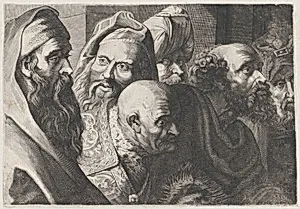
The Tribute Money
17th–18th century
Medium
Engraving; reverse copy (undescribed)
Dimensions
Sheet (Trimmed): 5 1/4 × 7 5/8 in. (13.3 × 19.3 cm)
Classification
Prints
Department
Drawings and Prints
Museum
Metropolitan Museum of Art, New York, NY
Credit
The Elisha Whittelsey Collection, The Elisha Whittelsey Fund, 1951
Accession Number
51.501.7052
Rights
Public Domain
Tags
Art Historical Context
This engraving, titled *The Tribute Money*, captures a pivotal New Testament scene in which Christ is questioned about paying taxes to Caesar. Created as a reverse copy in the 17th or 18th century, the small print (just over five by seven inches) reproduces a composition associated with Peter Paul Rubens. The work was likely engraved by Lucas Vorsterman I or an anonymous printmaker, reflecting the collaborative printmaking practices common in the Baroque period. Engravings played a vital role in disseminating famous paintings across Europe before photography existed. By reversing the original design onto a copper plate and printing it, artists and publishers could share religious and moral subjects with wider audiences. The crisp line work and careful shading typical of the medium highlight the figures of men gathered around Christ, emphasizing the dramatic moment of his reply: “Render unto Caesar the things that are Caesar’s.” Acquired by the Metropolitan Museum of Art in 1951 through the Elisha Whittelsey Fund, this print offers today’s visitors a window into how Baroque imagery traveled and influenced viewers long after the original painting was created. Its modest size made it suitable for personal study or inclusion in private collections, underscoring the democratic reach of reproductive prints in the history of art.
About the Artist
Anonymous|Peter Paul Rubens|Lucas Vorsterman I
In the vast tapestry of art history, "Anonymous" stands not as a singular individual but as a collective designation for countless unidentified creators whose works have endured across millennia. These artists, spanning prehistoric cave painters to medieval illuminators and folk craftsmen, produced the foundational layers of human visual culture. Prior to the Renaissance, when individual fame emer...