
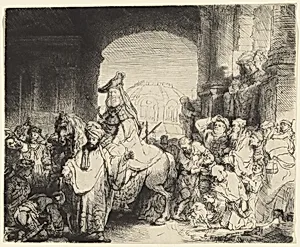
The Triumph of Mordecai
c. 1641
Medium
etching and drypoint on laid paper
Dimensions
sheet (trimmed close to plate mark): 17.2 x 21.3 cm (6 3/4 x 8 3/8 in.)
Classification
Department
CG-E
Museum
National Gallery of Art, Washington, D.C.
Credit
New Century Fund
Accession Number
1998.25.2
Rights
Public Domain
Art Historical Context
In the heart of Rembrandt van Rijn's masterful printmaking oeuvre stands *The Triumph of Mordecai* (c. 1641), an etching and drypoint on laid paper that captures a pivotal biblical moment from the Book of Esther. Here, the virtuous Jew Mordecai is paraded triumphantly through the streets of ancient Persia on the king's horse, led by his humbled enemy Haman. Created during Rembrandt's prolific Amsterdam years, this intimate work (17.2 x 21.3 cm) exemplifies the Dutch master's Baroque genius for drama and human emotion, rendered in a trimmed sheet that draws viewers close to the scene's intensity. Rembrandt's technique shines through his innovative use of etching—lines incised into a copper plate with acid—for precise outlines, combined with drypoint's soft, velvety burrs for rich shadows and textures. This blend produces extraordinary depth and luminosity, even on modest paper, making his prints rival paintings in expressiveness. A second state impression, it showcases his experimental approach, prized by collectors then and now. Housed in the National Gallery of Art's collection through the New Century Fund, this print not only reflects 17th-century fascination with Old Testament heroism amid religious tensions but also underscores Rembrandt's enduring legacy as a printmaker who elevated the medium to high art, inviting endless contemplation of triumph over adversity.
About the Artist
Rembrandt van Rijn · 1606–1669
Rembrandt Harmenszoon van Rijn (1606–1669) stands as one of the greatest visual artists in the history of Western art and the most important Dutch painter of the 17th century. Born in Leiden to a prosperous miller's family, Rembrandt transformed painting through his revolutionary use of light and shadow, his psychological depth in portraiture, and his elevation of etching to a fine art. His approx...