
The Triumphal Arch
1726 to 1750
Medium
etching
Classification
Department
CG-E
Museum
National Gallery of Art, Washington, D.C.
Credit
Print Purchase Fund (Rosenwald Collection)
Accession Number
1971.11.8
Rights
Public Domain
Art Historical Context
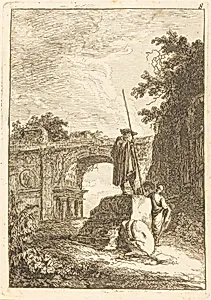
Hubert Robert's *The Triumphal Arch*, an etching created between 1726 and 1750, captures grandeur of ancient architecture in a delicate print medium. As a master of 18th-century French art, Robert—often called "Robert des Ruines" for his evocative depictions of crumbling Roman monuments—evokes the timeless allure of antiquity. This work, housed in the National Gallery of's CG-E department (acquired through the Print Purchase Fund from the Rosenwald Collection), exemplifies his skill in blending real historical structures with imaginative fantasy. Etching, Robert's chosen technique here, involves biting acid into a metal plate to create intricate lines, allowing for fine details like the arch's weathered stones, dramatic shadows, and atmospheric depth. This printmaking method was revolutionary in the Rococo-to-Neoclassical transition, making grand visions accessible beyond oil paintings. Robert drew inspiration from his Roman sojourns, fueling the era's fascination with classical ruins amid Enlightenment ideals of history and decay. For visitors, this piece whispers of 18th-century wanderlust for the past, inviting reflection on how triumphs fade yet inspire. A testament to Robert's enduring legacy in architectural capricci, it bridges art and archaeology in one elegant sheet.
About the Artist
Hubert Robert · 1733–1808
Hubert Robert, born on May 22, 1733, in Paris, emerged from a modest background; his father, Nicolas Robert, served the influential Choiseul family, whose patronage shaped the young artist's path. After completing his studies at the Jesuit Collège de Navarre in 1751, he entered the atelier of sculptor Michel-Ange Slodtz, who taught him design and perspective before encouraging a shift to painting....