
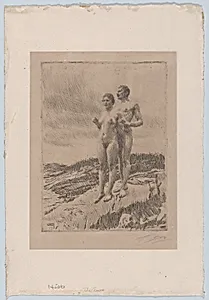
The Two
1916
Medium
Etching; second state of two
Dimensions
Plate: 7 13/16 × 5 13/16 in. (19.8 × 14.8 cm) Sheet: 13 5/16 × 9 1/16 in. (33.8 × 23 cm)
Classification
Prints
Department
Drawings and Prints
Museum
Metropolitan Museum of Art, New York, NY
Credit
Gift of Daniel Berger, 1979
Accession Number
1979.605
Rights
Public Domain
Tags
Art Historical Context
Anders Zorn's *The Two* (1916) is a masterful etching that exemplifies the Swedish artist's prowess in capturing the human form with remarkable intimacy and realism. Produced as the second state of two this print measures 7 13/16 × 5 13/16 inches on the plate, showcasing Zorn's expertise in intaglio techniques. Etching allowed him to incise fine lines into a metal plate, which were then bitten by acid to create rich, tonal depths—perfect for rendering the subtle textures of skin and light on nude figures. Depicting a male and female nude in close embrace, the work reflects Zorn's lifelong fascination with the nude body, often portrayed with sensual naturalism inspired by his studies in Paris and his admiration for Renaissance masters like Rembrandt. By 1916, amid World War I, Zorn—neutral in Sweden—continued his prolific output, blending Impressionist light effects with precise draftsmanship. This piece highlights his innovative use of drypoint in later states to add velvety burrs, enhancing emotional depth and immediacy. Now in the Metropolitan Museum of Art's Drawings and Prints department (gift of Daniel Berger, 1979), *The Two* invites visitors to appreciate Zorn's ability to distill human connection into elegant lines, bridging personal vulnerability with artistic virtuosity.
About the Artist
Anders Zorn · 1860–1920
Anders Zorn (1860–1920), one of Sweden's most celebrated artists, was born on February 18 in Utmeland near Mora in Dalarna, and raised on his maternal grandparents' farm in the nearby hamlet of Yvraden. Displaying prodigious talent from a young age, he attended school in Mora Strand until age twelve, followed by secondary grammar school in Enköping, where he excelled in drawing people and horses. ...