
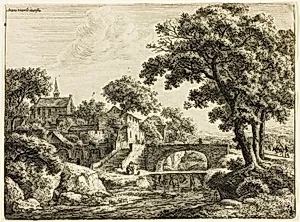
The Two Bridges
1650/60
Medium
Etching on paper
Dimensions
Image/plate: 15 × 20.3 cm (5 15/16 × 8 in.); Sheet: 15.2 × 20.5 cm (6 × 8 1/8 in.)
Classification
etching
Department
Prints and Drawings
Museum
Art Institute of Chicago
Accession Number
32782
Rights
Public Domain
Art Historical Context
**The Two Bridges** is a captivating etching by Anthonie Waterloo, a Dutch artist active during the Golden Age of the 17th century. Created around 1650–60, this print measures a modest 15 × 20.3 cm, inviting close inspection of its intricate details. Housed in the Art Institute of Chicago's Prints Drawings Department, it exemplifies Waterloo's mastery of landscape etching, a technique where acid etches fine lines into a metal plate to produce rich, tonal effects on paper. Waterloo, often called the "Dutch Claude Lorrain" for his poetic natural scenes, drew inspiration from the rugged beauty of the Dutch countryside and Italianate ideals. Etching allowed him to achieve delicate textures—think shimmering water under bridges or misty foliage—that captured the era's fascination with light, atmosphere, and the sublime in nature. During the 1650s, prints like this were prized collectibles, making high art accessible beyond oil paintings. This work highlights etching's revolutionary role in democratizing art, bridging elite patronage and public appreciation. Visitors will appreciate how Waterloo's precise lines evoke tranquility, a perfect emblem of Dutch ingenuity in printmaking.
About the Artist
Anthonie Waterloo · 1609–1690
Anthonie Waterloo (1609–1690) was a prominent Dutch Golden Age landscape artist, born on May 6 in Lille, then part of the Spanish Netherlands. Little is known of his early life beyond his mother, Magdalena Vaillant, who joined Amsterdam's Walloon Church in 1621, with Waterloo following in 1630; no records exist of formal training, and he was likely self-taught. Registered as a painter in Amsterdam...