
The Two Doorways
1879/80
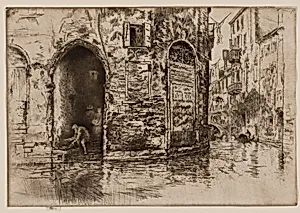
Medium
Etching and drypoint with foul biting in dark brown ink on off-white laid paper
Dimensions
Image, trimmed within platemark: 20.2 × 29.4 cm (8 × 11 5/8 in.); Sheet: 20.6 × 29.4 cm (8 1/8 × 11 5/8 in.)
Classification
etching
Department
Prints and Drawings
Museum
Art Institute of Chicago
Accession Number
29485
Rights
Public Domain
Art Historical Context
James McNeill Whistler’s *The Two Doorways*1879/80) captures the atmospheric allure of Venice, part of the artist’s acclaimed Second Venice Set of etchings. Exiled to Italy after his infamous libel trial against critic John Ruskin, Wh arrived in Venice in 1879 amid financial ruin. There, he produced around 50 etchings, revolutionizing printmaking with their loose, evocative lines that prioritize mood over meticulous detail—a hallmark of his Aesthetic movement philosophy, where “art for art’s sake” reigned supreme. Printed in dark brown ink on off-white laid paper using etching, drypoint, and foul biting, the work exemplifies Whistler’s technical mastery. Etching involves acid etching lines into a metal plate for precision, while drypoint’s direct needle scratches create velvety burrs for softness. Foul biting—unintended acid pits—adds a gritty, weathered texture, mirroring Venice’s aged doorways and evoking the city’s humid, decaying romance. At just 20.2 × 29.4 cm, the intimately trimmed image draws viewers into its subtle play of light and shadow. Housed in the Art Institute of Chicago’s Prints and Drawings department, this etching showcases Whistler’s influence on modern printmaking, blending Japanese-inspired simplicity with Western innovation. It invites us to linger on the quiet poetry of urban fragments, a timeless testament to Venice’s enduring mystique.
About the Artist
James McNeill Whistler · 1834–1903
James Abbott McNeill Whistler (1834-1903) was an American-born painter and printmaker who became a leading figure in the Aesthetic Movement and pioneer of Tonalism and Japonisme. He revolutionized art by championing "art for art's sake" and treating paintings as visual equivalents of musical compositions, titling works as "arrangements," "harmonies," and "nocturnes" to emphasize formal qualities o...