
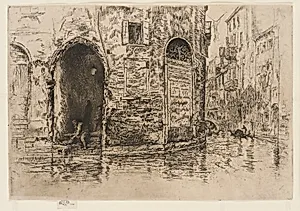
The Two Doorways
1879-1880
Classification
Department
Smithsonian Collection
Museum
Smithsonian American Art Museum
Credit
Gift of Charles Lang Freer
Accession Number
F1891.1
Rights
Public Domain
Tags
About this artwork
4, 3
Art Historical Context
James McNeill Whistler (1834-1903), the renowned American artist celebrated for his elegant, atmospheric works, created *The Two Doorways* between 1879 and 1880. This etching captures Whistler's mastery of printmaking during his influential sojourn in Venice, where he produced a celebrated series of etchings known as the Venice Set. Though the specific subject evokes Venetian architectural motifs—likely weathered doorways framing light and shadow—the piece exemplifies his commitment to "art for art's sake," prioritizing subtle tonal harmonies over narrative detail. As a print, *The Two Doorways* showcases etching's intimate technique: acid biting into a metal plate to create delicate lines and textures, allowing Whistler to evoke mood with minimal strokes. His style, aligned with Aestheticism, influenced American and European art, emphasizing beauty and harmony amid the late 19th-century shift toward modernism. Acquired as a gift from collector Charles Lang Freer, whose passion for Whistler's subtlety shaped the Smithsonian American Art Museum's holdings, this work resides in the Smithsonian Collection. It invites visitors to appreciate how Whistler's prints bridged fine art and graphic innovation, offering a window into 19th-century transatlantic cultural exchange.