
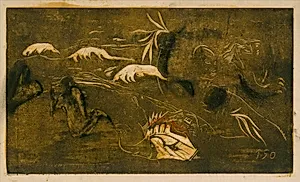
The Universe Is Created
1893–94
Medium
Woodcut printed in color on wove paper
Dimensions
Block: 8 1/16 × 13 7/8 in. (20.4 × 35.3 cm) Sheet: 10 1/4 × 19 1/16 in. (26 × 48.4 cm)
Classification
Prints
Department
Drawings and Prints
Museum
Metropolitan Museum of Art, New York, NY
Credit
Harris Brisbane Dick Fund, 1936
Accession Number
36.6.6
Rights
Public Domain
Tags
Art Historical Context
**The Universe Is Created**, a striking color woodcut by Paul Gauguin from1893–94, captures the artist's fascination with Polynesian mythology during his transformative stay in Tahiti. Created shortly after his arrival in 1891, this print draws from his travel journal *Noa No*, blending biblical creation narratives with Tahitian lore. Gauguin, a Post-Impressionist pioneer, rejected European conventions for a "primitive" aesthetic inspired by non-Western art, evident here in the intertwined human figures amid lush leaves symbolizing cosmic birth. Printed on wove paper from a modest block (8 1/16 × 13 7/8 in.), the work showcases Gauguin's innovative woodcut technique. He carved roughly by hand, layering bold colors to evoke Japanese ukiyo-e prints and folk traditions, achieving flat, vibrant planes that prioritize symbolism over realism. This experimental approach marked a shift in Western printmaking toward expressive, decorative power. Housed in the Metropolitan Museum of Art's Drawings and Prints department (acquired via the Harris Brisbane Dick Fund in 1936), the piece reflects Gauguin's quest for spiritual renewal. Its human figures and foliage invite visitors to ponder universal themes of origin, bridging cultures in a timeless, dreamlike vision.
About the Artist
Paul Gauguin · 1848–1903
Paul Gauguin (1848-1903) was a French Post-Impressionist painter whose bold experiments with color, form, and subject matter made him one of the most influential figures in the transition from 19th-century art to modernism. His rejection of European civilization for the perceived authenticity of 'primitive' cultures established an archetype of artistic exile that continues to resonate. Gauguin's ...