
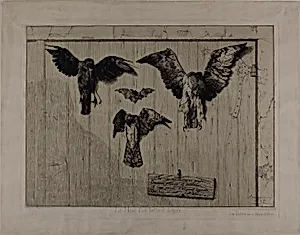
The Upper Part of a Door
Medium
Etching and drypoint on off-white laid paper, laid down on ivory wove paper
Dimensions
Plate: 30.5 × 40 cm (12 1/16 × 15 3/4 in.); Primary support: 28.5 × 38.7 cm (11 1/4 × 15 1/4 in.); Secondary support: 46.5 × 36 cm (18 5/16 × 14 3/16 in.)
Classification
etching
Department
Prints and Drawings
Museum
Art Institute of Chicago
Accession Number
41310
Rights
Public Domain
About this artwork
At the age of nineteen, Felix Braquemond executed this print, one of the best-known works of his career. On an old barn door are nailed a crow and an owl flanking a bat; beneath them is a sparrow hawk. The small message tacked to the door beneath the birds warns against the dangers of man's predatory nature.
Art Historical Context
Félix Henri Bracquemond *The Upper Part of a* (1852) is a masterful etching and dry, capturing the delicate ornamental details of architectural stonework. Created early in the artist's career, this print exemplifies Bracquemond's precision as a leading French printmaker of the 19th century, who helped revive etching as a fine art form amid the Romantic and emerging Realist movements. Housed in the Art Institute of Chicago's and Drawings department, it a generous plate size of 30.5 × 40 cm, printed on off-white laid paper and later laid down on ivory wove supports for preservation. Etching involves drawing lines into a wax-coated copper plate, which are then bitten by acid to create crisp, controlled marks, while drypoint adds a direct, incised burr for velvety textures and subtle tonal depth. Bracquemond's technique shines in rendering the door's carved motifs—likely inspired by Gothic or Renaissance architecture—showcasing his fascination with historical ornamentation. This work reflects mid-19th-century France's renewed interest in detailed reproductive prints, bridging artistry and craftsmanship. Though modest in subject, the piece highlights Bracquemond's influence on later movements like Japonisme and Impressionism through his innovative printmaking. A gem for admirers of technical virtuosity!
About the Artist
Félix Henri Bracquemond · 1833–1914
Félix Henri Bracquemond was born in Paris in 1833 and came of age during one of the most transformative periods in French art history. He trained primarily as an engraver and etcher, studying under Joseph Guichard before finding his true calling in printmaking. His technical mastery of etching quickly distinguished him among his contemporaries, and he formed lasting friendships with Édouard Manet,...