
The Urchin
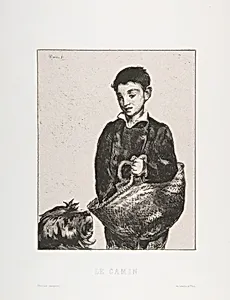
Medium
Lithograph on violet-toned chine collé, second state of two
Dimensions
image: 11 3/8 x 9 1/8in. (28.9 x 23.2cm) sheet: 21 3/8 x 14 7/8in. (54.3 x 37.8cm)
Classification
Prints
Department
Drawings and Prints
Museum
Metropolitan Museum of Art, New York, NY
Credit
Rogers Fund, 1922
Accession Number
22.60.19
Rights
Public Domain
Tags
Art Historical Context
Édouard Manet's *The Urchin* (1868) captures the spirit of Parisian street life through a masterful lithograph on violet-toned chine coll—the second state of two. by Lemercier & Cie this work measures 11 3/8 x 9 1/8 inches and depicts a cheeky young boy, evoking the "gamin" archetype of 19th-century urban youth Now housed in the Metropolitan Museum of Art's Drawings and Prints department (Rogers Fund, 1922), it exemplifies Manet's innovative printmaking. As a pioneer bridging Realism and Impressionism, Manet turned to lithography to share his bold visions with wider audiences beyond elite painting collectors. This medium allowed fluid, painterly strokes on stone, mimicking his loose brushwork, while the chine collé technique—gluing delicate Chinese paper to a sturdy sheet—preserved subtle tones and details on the violet ground, adding atmospheric depth. The second state likely refined these effects for greater impact. *The Urchin* reflects Second Empire France's social contrasts, spotlighting the vibrant, often overlooked lives of working-class boys amid Haussmann's modernizing Paris. Its tagged focus on "boys" underscores Manet's fascination with everyday humanity, making this print a window into his revolutionary gaze on contemporary society.
About the Artist
Edouard Manet|Lemercier & Cie. · 1832–1883
Édouard Manet (1832-1883) was a French painter who played a pivotal role in the transition from Realism to Impressionism, often called the 'Father of Modern Art.' Born into a wealthy Parisian family, Manet defied his father's wishes for a legal career to pursue painting, studying under academic artist Thomas Couture. His revolutionary works 'Le Déjeuner sur l'herbe' and 'Olympia' (both 1863) scand...