
The Village Fair
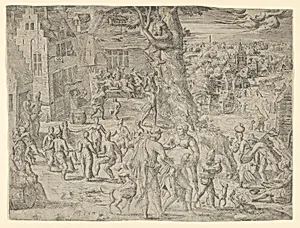
Medium
Etching
Dimensions
Sheet: 7 13/16 × 10 1/4 in. (19.9 × 26.1 cm)
Classification
Prints
Department
Drawings and Prints
Museum
Metropolitan Museum of Art, New York, NY
Credit
A. Hyatt Mayor Purchase Fund, Marjorie Phelps Starr Bequest and Mary Oenslager Fund, 2015
Accession Number
2015.625
Rights
Public Domain
Tags
Art Historical Context
Step into the lively world of 16th-century Flemish village life with *The Village Fair*, a delicate etching by Peeter van Borcht from 154. This intimate print, just under 8 by 10 inches, captures bustling energy of a rural festival: clusters of houses frame a crowded scene alive with villagers, playful dogs, and communal merriment. Van der Borcht, a Antwerp-based artist and engraver, excelled in genre scenes that brought everyday joys to life, reflecting the prosperity and social vibrancy of the Low Countries during the Renaissance. Etching, a relatively new technique in 1549—developed only decades earlier—allowed van der Borcht to achieve intricate lines and subtle textures, evoking the clamor of the fair with remarkable detail in such a compact format. Prints like this were revolutionary for their accessibility, disseminating images of peasant leisure to a wider audience beyond the elite, amid the era's growing print culture influenced by artists like Hieronymus Bosch. Acquired by The Metropolitan Museum of Art in 2015 through generous funds, *The Village Fair* offers a charming window into pre-industrial festivities, where humans and hounds mingled freely. It's a testament to how art preserved the simple pleasures of community in a time of religious and political upheaval.