
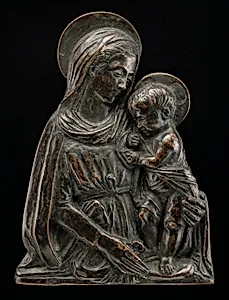
The Virgin and Child
1401 to 1500
Medium
bronze//Black patina revealing light bronze surface in rubbed areas
Dimensions
overall (silhouetted contour): 18.9 x 14.1 cm (7 7/16 x 5 9/16 in.) gross weight: 641 gr
Classification
Sculpture
Department
CSD
Museum
National Gallery of Art, Washington, D.C.
Credit
Samuel H. Kress Collection
Accession Number
1957.14.138
Rights
Public Domain
Art Historical Context
Nestled in the Samuel H. Kress Collection the National Gallery of Art *The Virgin and Child* Antonio Rossellino exemplifies the tender devotional art of 15th-century Florence. Crafted between 1401 and 1500, this small bronze sculpture captures the quintessential Renaissance theme of maternal love and divine grace, reflecting the era's deepening humanism amid lingering Gothic influences. Rossellino, a sculptor from the Florentine school was renowned for his expressive marble tombs and reliefs, but this intimate piece showcases his skill in bronze casting, a medium prized for its durability and luminous quality. The sculpture's black patina, worn to reveal lighter bronze in rubbed areas, speaks to centuries of reverent handling—likely as a private prayer object for a wealthy patron. Measuring just 18.9 x 14.1 cm and weighing 641 grams, its portable scale made it ideal for personal devotion, evoking the quiet spirituality of Renaissance households. The silhouetted contour emphasizes graceful forms, blending idealized beauty with emotional warmth characteristic of early Italian Renaissance sculpture. This work not only highlights Rossellino's technical prowess in patination and modeling but also underscores the cultural centrality of the Virgin Mary in Christian iconography, bridging medieval piety with Renaissance naturalism. A gem for visitors, it invites contemplation of faith's enduring artistry.
About the Artist
Antonio Rossellino · 1427–1479
Comment on works: sculptor