
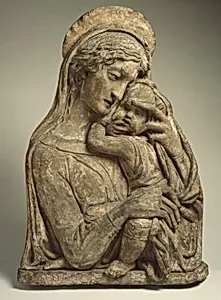
Madonna and Child
15th century or later, after ca. 1450 model
Medium
Terracotta, polychromed
Dimensions
29 × 20 1/2 in. (73.7 × 52.1 cm)
Classification
Sculpture
Culture
Italian, Florence
Department
European Sculpture and Decorative Arts
Museum
Metropolitan Museum of Art, New York, NY
Credit
Rogers Fund, 1912
Accession Number
12.78
Rights
Public Domain
Tags
Art Historical Context
Nestled in the Metropolitan Museum of Art's European Sculpture and Decorative collection, this *Madonna and Child* a poignant terracotta sculpture attributed to Donatello, the Florentine master of the early Renaissance. Dating to the 15th century or, it follows a model from around 1450, capturing the tender intimacy between the Virgin Mary and the Christ Child—a ubiquitous theme in Italian devotional art. Measuring 29 × 20½ inches, its modest scale suggests it was likely intended for private worship in a home or chapel, evoking personal piety amid Florence's burgeoning Renaissance humanism. Donatello (c. 1386–1466), a pioneer in naturalistic sculpture, revolutionized the medium with his innovative use of terracotta, a malleable clay that allowed for detailed modeling before firing. Here, the surface is polychromed—vibrantly painted in period colors—to enhance emotional realism and lifelike presence, bridging sculpture and painting. This technique democratized sacred imagery, making it accessible beyond marble monuments. Acquired through the Rogers Fund in 1912, this work exemplifies Florentine artistry's blend of classical revival and spiritual depth, inviting visitors to ponder the Renaissance's fusion of faith, innovation, and human emotion.
About the Artist
Donatello · 1380–1466
Important and very influential Florentine sculptor in the media of marble, bronze, and wood. Although he himself was not not a cultured intellectual (as was typical for artists of his generation and earlier), he associated with early Renaissance humanists in Florence, Rome, and Padua. In his art, he made new references to Antique forms, and to this added new expressive and technical virtuousity to...