
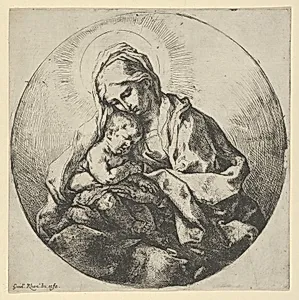
The Virgin holding the infant Christ with the fingers of her right hand hidden, a circular composition
ca. 1600–1640
Medium
Etching
Dimensions
Sheet (Trimmed): 6 1/4 × 6 1/4 in. (15.8 × 15.9 cm)
Classification
Prints
Department
Drawings and Prints
Museum
Metropolitan Museum of Art, New York, NY
Credit
Harris Brisbane Dick Fund, 1926
Accession Number
26.70.4(90)
Rights
Public Domain
Tags
Art Historical Context
Guido Reni, a leading figure of the Bolognese school in the early Baroque period, created this intimate etching of the Madonna and Child around 1600–1640. The circular format, known as a tondo, lends the composition a sense of harmony and completeness often associated with devotional images meant for private contemplation. Reni’s elegant linework captures the tender interaction between mother and son, with the Virgin’s hidden fingers adding a subtle, naturalistic touch that draws the viewer into the sacred moment. As an etching, the work reflects the medium’s growing importance in the seventeenth century for disseminating religious imagery beyond the walls of churches and palaces. Reni, trained under the Carracci family and influenced by Raphael’s classical ideals, brought a refined grace to his prints that appealed to collectors across Europe. This small sheet, measuring just over six inches in diameter, exemplifies how printmaking allowed artists to explore monumental themes on an accessible scale. Today housed in the Metropolitan Museum of Art, the etching highlights Reni’s enduring reputation for devotional subjects that blend emotional warmth with formal beauty, inviting viewers to appreciate both its spiritual resonance and technical finesse.
About the Artist
Guido Reni · 1575–1642
Guido Reni (1575–1642) was one of the most celebrated Italian painters of the Baroque era and the dominant figure of the Bolognese School. Born into a family of musicians in Bologna, he trained first with Denys Calvaert before joining the influential Accademia degli Incamminati led by Ludovico Carracci. Reni achieved international fame through his idealizing style that combined Baroque dynamism wi...