
The Vision of Ezekiel
1554 (republished 1595)
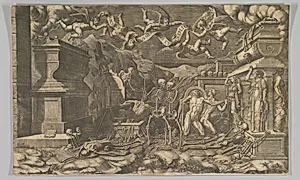
Medium
Etching; fourth state of six (BLL)
Dimensions
Sheet (Trimmed): 16 5/16 × 26 5/8 in. (41.5 × 67.7 cm)
Classification
Prints
Department
Drawings and Prints
Museum
Metropolitan Museum of Art, New York, NY
Credit
Harris Brisbane Dick Fund, 1953
Accession Number
53.600.595
Rights
Public Domain
Tags
Art Historical Context
The Vision of Ezekiel, an etching created by Giorgio Ghisi after a design by Giovanni Battista Bertano and published by Cristoforo Bianchi, captures a dramatic biblical scene from the Book of Ezekiel. Dated 1554 and reissued in 1595, this fourth state of six impressions depicts the prophet’s vision of dry bones reassembling into living figures, a powerful symbol of resurrection and renewal. The work’s large scale—over 26 inches wide—allows for intricate details of skeletons, men, and women emerging in a dynamic landscape. As a reproductive print, the etching played a vital role in spreading religious imagery during the Renaissance and Counter-Reformation. Ghisi’s masterful use of the medium, with its fine lines and tonal range, brought complex compositions to wider audiences beyond those who could view original paintings or frescoes. Its presence in the Metropolitan Museum’s collection highlights the enduring appeal of such prints as both devotional tools and artistic achievements. Visitors today can appreciate how this work blends spiritual narrative with technical precision, inviting reflection on themes of hope and transformation that resonated in 16th-century Europe.
About the Artist
Giorgio Ghisi|Giovanni Battista Bertano|Cristoforo Bianchi · 1520–1582
Giorgio Ghisi (c. 1520–1582) was one of the most accomplished engravers of the Italian Renaissance, renowned for translating the monumental compositions of Raphael, Giulio Romano, and Michelangelo into the exacting medium of the burin. Born in Mantua, he trained in an environment shaped by the legacy of Giulio Romano's decoration of the Palazzo del Te, and the grandeur of that Mannerist tradition ...