
The Visitors' Boat
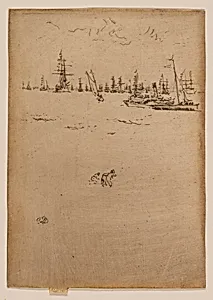
Medium
Etching with foul biting in black ink on cream laid paper
Dimensions
Image, trimmed within platemark: 17.7 × 12.6 cm (7 × 5 in.); Sheet: 18 × 12.6 cm (7 1/8 × 5 in.)
Classification
etching
Department
Prints and Drawings
Museum
Art Institute of Chicago
Accession Number
14327
Rights
Public Domain
Art Historical Context
James McNeill Whistler, pioneering figure in the Aesthetic movement, created *The Visitors' Boat* 1887 as part of his acclaimed Second Venice Set of etchings. This intimate print captures the serene waterways of Venice, likely depicting a gondola carrying visitors amid the city's misty canals. Whistler's work emphasizes tonal harmony and subtle atmosphere over literal detail, reflecting his philosophy of "art for art's sake" and his fascination with Japanese prints. The medium—etching with foul biting black ink on cream laid—showcases Whistler's innovative printmaking techniques. Etching involves drawing into a wax ground on a metal plate, which is then bitten by acid to create lines. Foul biting, an accidental yet embraced corrosion, adds textured, granular effects that enhance the print's velvety depth and evoke Venice's humid haze. At just 17.7 × 12.6 cm, the trimmed image invites close viewing, revealing Whistler's mastery in achieving painterly qualities through print. Housed in the Art Institute of Chicago's Prints and Drawings department, this etching exemplifies Whistler's late-19th-century push to elevate printmaking as fine art. Produced during his return visits to Venice, it distills the city's elusive beauty into a timeless, evocative image that continues to captivate visitors with its quiet poetry.
About the Artist
James McNeill Whistler · 1834–1903
James Abbott McNeill Whistler (1834-1903) was an American-born painter and printmaker who became a leading figure in the Aesthetic Movement and pioneer of Tonalism and Japonisme. He revolutionized art by championing "art for art's sake" and treating paintings as visual equivalents of musical compositions, titling works as "arrangements," "harmonies," and "nocturnes" to emphasize formal qualities o...