
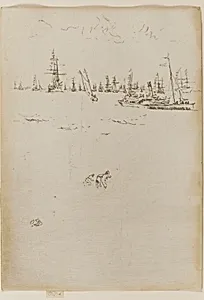
The Visitors' Boat
Classification
Department
Smithsonian Collection
Museum
Smithsonian American Art Museum
Credit
Gift of Charles Lang Freer
Accession Number
F1888.2
Rights
Public Domain
Tags
About this artwork
Whistler etchings are identified by "G" numbers as assigned in "James McNeill Whistler: The Etchings, a catalogue raisonne," by Margaret F. McDonald, Grischka Petri, Meg Hausberg, and Joanna Meacock (University of Glasgow, 2012), http://etchings.arts.gla.ac.uk. This print is G303 state 1 of 1.
Art Historical Context
James McNeill Whistler (1834–1903), the renowned American-born artist who championed "art for art's sake," created *The Visitors' Boat* 1887 as part of his masterful etching series. A pioneer of Aestheticism and tonal harmony, Whistler drew inspiration from everyday scenes, often capturing subtle atmospheric effects with boats and waterways—a motif echoing his famous Thames etchings from the 1850s and Venetian works of the 1880s. This print, cataloged as G303 (state 1 of 1) in the definitive University of Glasgow *James McNeill Whistler: The Etchings* raisonné, exemplifies his precise yet evocative style. Etching, Whistler's preferred medium here, involves incising lines into a metal plate with acid, allowing for delicate tonal gradations and intricate details that mimic painting's subtlety. In *The Visitors' Boat*, these techniques likely highlight the gentle sway of a vessel against water, evoking quiet introspection amid industrial-era Britain and America. The work's inclusion in the Smithsonian American Art Museum's collection underscores its place in American art history. Generously gifted by industrialist Charles Lang Freer, Whistler's greatest patron who amassed over 1,000 of his prints and paintings, this etching reflects Freer's passion for Whistler's innovative vision. Visitors today can appreciate how it bridges 19th-century realism with modernist abstraction, inviting a serene pause amid the museum's treasures.