
The Waltz
1891
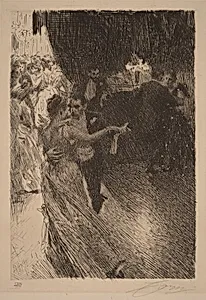
Medium
etching on laid paper
Dimensions
plate: 31.6 × 21.6 cm (12 7/16 × 8 1/2 in.) sheet: 46.9 × 35 cm (18 7/16 × 13 3/4 in.)
Classification
Department
CG-E
Museum
National Gallery of Art, Washington, D.C.
Credit
Rosenwald Collection
Accession Number
1943.3.8847
Rights
Public Domain
Art Historical Context
**The Waltz**, a masterful etching created by Swedish artist Anders Zorn in 1, captures the graceful rhythm of a dancing couple in a moment of elegant intimacy. Printed on laid paper—a traditional support with visible chain lines that adds to its tactile authenticity—the plate measures 31.6 × 21.6 cm, allowing for intricate details within a compact format. Housed in the National Gallery of Art Rosenwald Collection, this print exemplifies Zorn's international acclaim during the late 19th century, when he was celebrated for blending Realism with a luminous, painterly touch. Zorn, a virtuoso printmaker, elevated etching to new heights through his precise control of line and tone. Using the intaglio process—where acid etches fine lines into a metal plate—he achieved velvety textures and subtle gradations that mimic the flow of fabric and light on skin, evoking the whirl of the waltz. This technique not only highlighted his technical prowess but also bridged painting and printmaking, making high art accessible through editions. Culturally, *The Waltz* reflects the fin-de-siècle fascination with ballroom dance as a symbol of romance and social refinement in Europe. Zorn's work, with its sensual energy, underscores his signature style of capturing fleeting human connections, inviting viewers to step into an era of opulent leisure. A gem of the print collection (CG-E), it remains a testament to etching's enduring power to convey motion and emotion.
About the Artist
Anders Zorn · 1860–1920
Anders Zorn (1860–1920), one of Sweden's most celebrated artists, was born on February 18 in Utmeland near Mora in Dalarna, and raised on his maternal grandparents' farm in the nearby hamlet of Yvraden. Displaying prodigious talent from a young age, he attended school in Mora Strand until age twelve, followed by secondary grammar school in Enköping, where he excelled in drawing people and horses. ...