
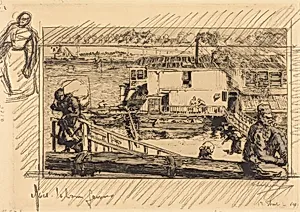
The Wash-house (Le lavoir)
1891
Medium
etching [touched proof]
Classification
Department
CG-E
Museum
National Gallery of Art, Washington, D.C.
Credit
Rosenwald Collection
Accession Number
1943.3.5593
Rights
Public Domain
Art Historical Context
Auguste Lepère's *The Wash-house (Leoir)*, created in 1891, a quintessential slice of rural French life at the turn of the century. As a master French engraver and illustrator (1849–1918), Lepère specialized in depicting everyday scenes with a keen eye for detail and atmosphere, often drawing from the naturalist tradition that celebrated ordinary people and places. This etching portrays a communal wash-house—a vital social hub in 19th-century villages where gathered to launder clothes by hand, reflecting the rhythms of pre-industrial labor and community bonds. Rendered as a "touched proof," this print showcases Lepère's etching technique, where acid etches intricate lines into a metal plate for tonal depth and texture, enhanced here with the artist's subtle hand-applied touches in pencil or ink. Such proofs were prized for their immediacy, bridging the gap between sketch and finished edition. Housed in the National Gallery of Art's Rosenwald Collection, it exemplifies the revival of original printmaking in fin-de-siècle France, blending technical virtuosity with social observation. This work invites us to linger on the steam rising from soapy waters and the camaraderie of shared chores, evoking a vanishing world just before modern conveniences transformed daily life. A charming window into Lepère's affection for the French countryside!
About the Artist
Auguste Lepère · 1849–1918
Auguste-Louis Lepère (1849–1918), son of the sculptor François Lepère, was born in Paris on November 30, 1849, into an artistic family that shaped his early path. At age thirteen, he apprenticed in the Paris studio of the English wood engraver Joseph Burn Smeeton, honing his skills in wood engraving until 1867. He furthered his training with drawing classes under Horace Lecoq de Boisbaudran at the...