
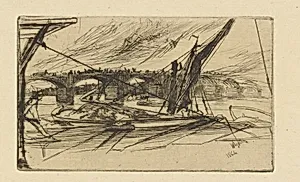
Vauxhall Bridge
Classification
Department
Smithsonian Collection
Museum
Smithsonian American Art Museum
Credit
Gift of Charles Lang Freer
Accession Number
F1898.313
Rights
Public Domain
Tags
About this artwork
3, 2
Art Historical Context
James McNeill Whistler’s *Vauxhall Bridge*1861) captures a pivotal moment in the artist’s early career, when the American-born painter and printmaker, living in London, turned his gaze to the industrial Thames River. This etching depicts the iconic Vauxhall Bridge, a of Victorian engineering spanning the waterway in the heart of England’s bustling capital. Whistler, known for his pioneering role in the Aesthetic movement and subtle tonal harmonies, began experimenting with printmaking around this time, producing intimate views that blend realism with atmospheric poetry. As part of Whistler’s celebrated “Thames Set” of etchings, this work showcases his mastery of the etching technique—an intaglio process where acid bites into a metal plate to create fine, expressive lines. The result is a delicate interplay of light, shadow, and fog, evoking the hazy romance of urban life amid Britain’s rapid modernization. Whistler’s prints revitalized the medium in the 19th century, influencing generations of artists with their emphasis on mood over meticulous detail. A cherished piece from the Charles Lang Freer collection, gifted to the Smithsonian American Art Museum, *Vauxhall Bridge* highlights the transatlantic cultural exchange Whistler embodied. Freer, an avid collector of Whistler’s oeuvre, ensured these gems preserve the artist’s innovative spirit for today’s visitors, inviting us to ponder the beauty hidden in everyday infrastructure.