
The Weary Ploughman, or The Herdsman, or Tardus Bubulcus
begun 1858
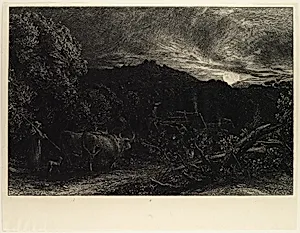
Medium
Etching; eighth state of eight
Dimensions
sheet: 6 1/4 x 7 15/16 in. (15.8 x 20.2 cm) plate: 7 1/2 x 10 5/16 in. (19 x 26.2 cm) image: 5 3/16 x 7 7/8 in. (13.2 x 20 cm)
Classification
Prints
Department
Drawings and Prints
Museum
Metropolitan Museum of Art, New York, NY
Credit
Harris Brisbane Dick Fund, 1917
Accession Number
17.3.2404
Rights
Public Domain
Tags
Art Historical Context
Samuel Palmer's *The Weary Ploughman, or The Herdsman, or Tardus Bubulcus* (begun 1858) is a poignant etching from the eighth and final state of eight, capturing the artist's enduring fascination with pastoral life. Palmer, a key figure in British Romanticism and founder of the visionary Shoreham Ancients group, drew inspiration from William Blake's mystical landscapes. This print, now in the Metropolitan Museum of Art's Drawings and Prints collection (Harris Brisbane Dick Fund, 1917), measures a modest 5 1/16 x 7 7/8 inches in its image area, inviting intimate contemplation. The scene evokes quiet rural toil at twilight, featuring a weary herdsman amid cows, shadowed trees, and a luminous moon—hallmarks of Palmer's idyllic yet melancholic vision of the English countryside. Etching allowed Palmer to achieve rich tonal depth and intricate textures, burnishing the plate for subtle highlights that mimic moonlight on foliage and weary figures. This late work reflects his shift toward classical restraint while retaining Romantic spirituality, blending labor's hardship with nature's sublime poetry. As a testament to 19th-century printmaking mastery, it highlights Palmer's revival of pastoral themes amid industrialization, offering visitors a serene escape into an idealized agrarian world.
About the Artist
Samuel Palmer · 1805–1881
Samuel Palmer was born on 27 January 1805 in Newington, London, the son of a bookseller and sometime Baptist minister. He had little formal schooling and almost no conventional artistic training, yet he possessed an instinctive gift for drawing that led him to exhibit Turner-inspired works at the Royal Academy when he was only fourteen years old. In 1824 his mentor, the painter John Linnell, intro...