
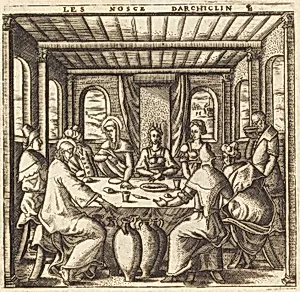
The Wedding at Cana (Christ Changes Water to Wine)
probably c. 1576/1580
Medium
engraving
Dimensions
sheet: 6 × 6.1 cm (2 3/8 × 2 3/8 in.)
Classification
Department
CG-E
Museum
National Gallery of Art, Washington, D.C.
Credit
Rosenwald Collection
Accession Number
1964.8.1023
Rights
Public Domain
Art Historical Context
Léonard Gaultier's *The Wedding at Cana (Christ Changes Water to Wine, an exquisite engraving likely created around 1576–1580, captures a pivotal biblical miracle from the Gospel of John. This small print, measuring just 6 × 6.1 cm, showcases the French artist's mastery in rendering crowded scenes with intricate detail. Gaultier, a prominent engraver of the late 16th century, worked during a time of religious fervor in France amid the Wars of Religion, works that reinforced Catholic devotion through accessible imagery. The scene depicts Jesus performing his first public miracle at a Galilean wedding feast, transforming water into wine at his mother's request—a symbol of divine abundance and the dawning Messianic age. Gaultier's engraving likely reproduces a larger composition, possibly inspired by earlier paintings like Veronese's grand canvas, adapting it for devotional use. As part of the National Gallery of Art's Rosenwald Collection, it highlights the era's printmaking boom, where engravings democratized art for books of hours, prayer books, and private altars. Engraving's technique—incising fine lines into a copper plate for precise ink transfer—allowed Gaultier to pack narrative drama into this tiny format, with swirling figures and architectural elements evoking Mannerist elegance. This print not only educates on Christian theology but also exemplifies how 16th-century prints bridged elite art and everyday piety, making sacred stories intimately portable.
About the Artist
Léonard Gaultier · 1561–1641
Léonard Gaultier, a prolific French engraver born in Mainz around 1561, established himself as a prominent printmaker and publisher in Paris, where he died in 1641. Operating from addresses like "A l'Arche de Noé" on rue du Monceau-Saint-Gervais by 1585, he produced book illustrations, frontispieces, title pages, broadsides, almanacs, and standalone prints, often collaborating with publishers such...