
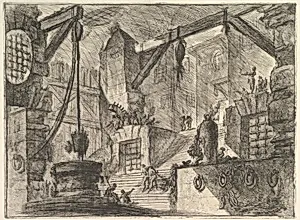
The Well, from "Carceri d'invenzione" (Imaginary Prisons)
ca. 1749–50
Medium
Etching, engraving, scratching, burnishing, lavis; first state of six (Robison)
Dimensions
Sheet: 19 7/16 x 25 in. (49.4 x 63.5 cm) Plate: 16 x 21 9/16 in. (40.6 x 54.8 cm)
Classification
Prints
Department
Drawings and Prints
Museum
Metropolitan Museum of Art, New York, NY
Credit
Harris Brisbane Dick Fund, 1937
Accession Number
37.45.3(28)
Rights
Public Domain
Tags
Art Historical Context
Welcome to the Metropolitan Museum of Art's Drawings and Prints department, where Giovanni Battista Piranesi's * Well*, from the groundbreaking series *Carceri'invenzione* (inary Prisons), ca. 1749–50, captivates with its labyrinthine vision. Created in collaboration with Giovanni Bouchard, etching plunges viewers into a colossal, fictional underworld of towering arches, spiraling staircases, and a central well guarded by shadowy human figures. Part of Piranesi's iconic 14 series (later expanded), it embodies the artist's obsession with architecture's sublime potential, blending real Roman influences with nightmarish fantasy to evoke entrapment and infinity. Piranesi masterfully employed etching, engraving, scratching, burnishing, and lavis in this rare first state of six, allowing intricate details to emerge from deep shadows. The vast plate (16 x 21 9/16 in.) creates an illusion of boundless space on the larger sheet, a technical feat that influenced generations of artists, architects, and even writers like Edgar Allan Poe. These "prisons" weren't literal jails but metaphors for the human condition, reflecting 18th-century Enlightenment tensions between reason and the irrational. Acquired through the Harris Brisbane Dick Fund in 1937, *The Well* remains a cornerstone of printmaking history, inviting you to lose yourself in its moody depths and ponder the architecture of the mind.
About the Artist
Giovanni Battista Piranesi|Giovanni Bouchard · 1720–1778
Giovanni Battista Piranesi (1720–1778) was an Italian printmaker, architect, and antiquarian whose visionary etchings of Rome and imaginary prisons revolutionized architectural representation and profoundly influenced both Neoclassicism and Romanticism. Piranesi stands as one of the most important printmakers of the eighteenth century, fundamentally shaping European perceptions of ancient Rome an...