
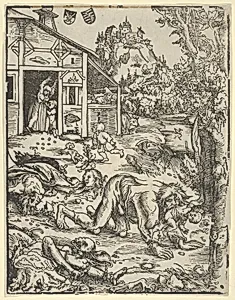
The Werewolf or the Cannibal
Medium
Woodcut
Dimensions
Sheet: 6 1/2 × 5 1/16 in. (16.5 × 12.8 cm)
Classification
Prints
Department
Drawings and Prints
Museum
Metropolitan Museum of Art, New York, NY
Credit
Harris Brisbane Dick Fund, 1942
Accession Number
42.45.1
Rights
Public Domain
Tags
Art Historical Context
In the shadowy realm of Renaissance folklore, Lucas Cranach the Elder’sThe Werewolf or the Cann* captures a gripping tale of monstrosity through the bold medium of woodcut. by this prolific German artist (1472–1553), a key figure in the Northern and court painter to the Electors of Saxony, the print measures a compact 6 1/2 × 5 1/16 inches on a sheet of paper. Woodcuts like this were revolutionary for their time, carved into wooden blocks and hand-printed to produce affordable, widely distributable images that brought dramatic narratives to everyday audiences. The title evokes primal fears of lycanthropy or cannibalism, likely depicting a ferocious figure amid men, women, and children—common motifs in 16th-century German prints warning against human savagery or moral decay. Cranach’s precise line work and dynamic compositions, hallmarks of his style blending Gothic detail with emerging Renaissance naturalism, heighten the scene’s tension, making the supernatural feel viscerally real. Housed in the Metropolitan Museum of Art’s Drawings and Prints department (Harris Brisbane Dick Fund, 1942), this undated work exemplifies how prints democratized art, spreading cautionary folklore across Europe and influencing later depictions of the macabre in literature and visual culture. A chilling reminder of humanity’s wild underbelly!
About the Artist
Lucas Cranach the Elder · 1472–1553
Lucas Cranach the Elder (c. 1472-1553) was one of the most prominent German Renaissance painters and a key artistic figure of the Protestant Reformation. Born in Kronach, Franconia, to the painter Hans Maler, Cranach began his career in Vienna around 1502, where he became one of the founders of the Danube School, a movement characterized by expressive landscape painting and emotional force. His ea...