
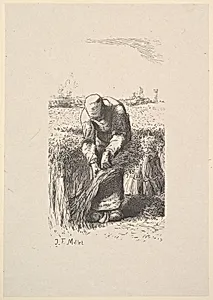
The Wheat Gatherer
Medium
Woodcut on chine collé
Dimensions
block: 5 5/16 x 2 15/16 in. (13.5 x 7.5 cm)
Classification
Prints
Department
Drawings and Prints
Museum
Metropolitan Museum of Art, New York, NY
Credit
Harris Brisbane Dick Fund, 1927
Accession Number
27.81.2(37)
Rights
Public Domain
Tags
Art Historical Context
"The Wheat Gatherer," created in 1853, captures the quiet dignity of rural labor through the work of Jean-François Millet, a leading figure in the Realist movement, in collaboration with wood engraver Jacques-Adrien Lavieille. Millet, renowned for his sensitive portrayals of peasant life, here depicts a solitary figure gathering wheat, emphasizing the strength and humility of agricultural workers. This small yet powerful print reflects the mid-nineteenth-century interest in honest representations of everyday toil, offering viewers a window into the rhythms of French countryside existence. Executed as a woodcut on chine collé, the print combines the bold, graphic qualities of wood engraving with the delicate surface of thin Asian paper mounted onto a sturdier sheet. This technique allowed for fine detail and tonal subtlety while making the image reproducible and affordable. Measuring just over five inches tall, the work exemplifies how Millet and his contemporaries used printmaking to share scenes of working life with a broader audience. Housed in the Metropolitan Museum of Art’s Department of Drawings and Prints, this piece highlights the cultural importance of celebrating ordinary human endeavor during a period of social change. Its focus on laboring figures continues to resonate, reminding us of the enduring beauty found in humble, essential work.
About the Artist
Jean-François Millet|Jacques-Adrien Lavieille · 1814–1875
Jean-François Millet (1814-1875) was a French painter and one of the founders of the Barbizon school, whose dignified depictions of peasant laborers transformed how art could represent rural life. His monumental images of sowers, gleaners, and field workers elevated common people to subjects previously reserved for mythological or historical figures, making him a pivotal figure in the development ...