
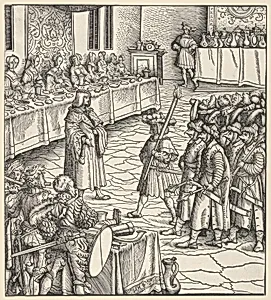
The White King's Skill in Conducting Masquerades, from Der Weisskunig
Medium
Woodcut; proof (Hollstein)
Dimensions
Sheet: 8 3/4 × 7 13/16 in. (22.2 × 19.9 cm)
Classification
Prints
Department
Drawings and Prints
Museum
Metropolitan Museum of Art, New York, NY
Credit
Harris Brisbane Dick Fund, 1943
Accession Number
43.3.3
Rights
Public Domain
Tags
Art Historical Context
This woodcut proof, titled *The White King's Skill in Masquerades*, is a captivating page from *Der Weisskunig*The White King), an ambitious illustrated biography by Holy Roman Emperor Maximilian I 1514–16. Created collaboratively by artist Hans Burgkmair, woodcutter Jost deker, and contributor Marx Treitz-Sauer von Ehrentreitz, depicts the emperor—symbolized as the "White King"—orchestrating a lively masquerade, surrounded by kings, men, women, and portraits in festive attire. At roughly 8¾ × 7⅞ inches, this intimate sheet captures the opulence of Renaissance court life. As a woodcut proof from the Hollstein catalogue, it exemplifies early 16th-century German printmaking's innovation, where Burgkmair's designs brought fine detail and narrative depth to the medium. Woodcuts like this democratized art, allowing complex scenes to be reproduced for books and dissemination across Europe. *Der Weisskunig* served as Maximilian's propaganda masterpiece, blending autobiography with fantasy to glorify his virtues, including mastery of entertainments like masquerades—elaborate events blending dance, disguise, and diplomacy. Held in the Metropolitan Museum of Art's Drawings and Prints department (Harris Brisbane Dick Fund, 1943), this proof offers a rare glimpse into Northern Renaissance collaboration and the era's cultural splendor, inviting us to imagine the emperor's charismatic revelry.
About the Artist
Hans Burgkmair|Jost de Negker|Marx Treitz-Sauerwein von Ehrentreitz · 1473–1531
Hans Burgkmair the Elder (1473–1531) was a German painter and printmaker who became one of the leading artists of the Renaissance in Augsburg. Born into a family of painters — his father, Thoman Burgkmair, was a respected artist — he likely received his initial training in his father's workshop. He may also have studied with Martin Schongauer in Colmar, and a probable visit to Italy around 1507 ex...