
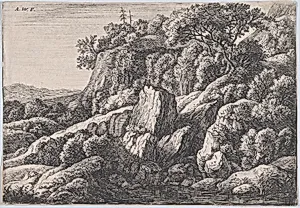
The Wilderness Covered with Rocks
17th century
Medium
Etching
Dimensions
sheet: 4 1/2 x 6 9/16 in. (11.5 x 16.7 cm)
Classification
Prints
Department
Drawings and Prints
Museum
Metropolitan Museum of Art, New York, NY
Credit
Gift of Kenneth Grebinar, 2005
Accession Number
2005.377.10
Rights
Public Domain
Tags
Art Historical Context
Step into the rugged beauty of Anthonie Waterloo's *The Wilderness Covered with Rocks a captivating 17th-century etching that evokes the untamed Dutch countryside. Created during the Dutch Golden Age, when landscape art flourished as a celebration of nature's majesty, this small-scale print (4 1/2 x 6 9/16 inches) masterfully captures a dense thicket of trees and jagged rock formations, drawing viewers into a wild, atmospheric scene. Waterloo, a Dutch etcher renowned for his intricate landscapes, employed the etching technique—acid biting into a metal plate to create fine, expressive lines—to render the textured bark, twisted branches, and craggy boulders with remarkable precision. This medium was revolutionary in the 1600s, allowing artists like Waterloo to produce affordable multiples that brought poetic visions of nature to a wider audience, influencing later Romantic landscapists. Today, this gem resides in the Metropolitan Museum of Art's Drawings and Prints department, a 2005 gift from Kenneth Grebinar. It reminds us how 17th-century artists transformed everyday wilderness into timeless meditations on solitude and the sublime.
About the Artist
Anthonie Waterloo · 1609–1690
Anthonie Waterloo (1609–1690) was a prominent Dutch Golden Age landscape artist, born on May 6 in Lille, then part of the Spanish Netherlands. Little is known of his early life beyond his mother, Magdalena Vaillant, who joined Amsterdam's Walloon Church in 1621, with Waterloo following in 1630; no records exist of formal training, and he was likely self-taught. Registered as a painter in Amsterdam...