
The Winged Hat
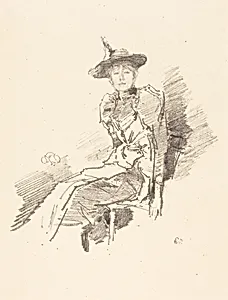
Medium
lithograph in black on laid paper
Dimensions
image: 17.9 × 17.4 cm (7 1/16 × 6 7/8 in.) sheet: 30.9 × 20.8 cm (12 3/16 × 8 3/16 in.)
Classification
Department
CG-W
Museum
National Gallery of Art, Washington, D.C.
Credit
Rosenwald Collection
Accession Number
1943.3.8685
Rights
Public Domain
Art Historical Context
James McNeill Whistler’s *The Winged Hat*1890) is a captivating lithograph in black on laid paper, measuring a intimate 17.9 × 17.4 cm for the image itself. Created during the artist’s mature period, this print exemplifies Whistler’s mastery of subtle tonal effects and his commitment to “art for art’s sake,” a hallmark of the Aesthetic. An American expatriate in London, Whistler drew inspiration from Japanese art and French etching traditions, prioritizing harmony, mood, and beauty over narrative. Lithography allowed Whistler to achieve painterly qualities akin to his famous oil nocturnes, using greasy crayon on stone to produce velvety blacks and delicate grays. This medium was revolutionary for printmakers in the late 19th century, bridging fine art and reproduction while enabling editions of exceptional quality. *The Winged Hat* showcases his innovative transfer lithography technique, where drawings were traced onto stone for precise, atmospheric rendering—likely evoking a whimsical or ethereal figure through its titular motif. Housed in the National Gallery of Art’s Rosenwald Collection (Department CG-W), this work highlights Whistler’s profound influence on modern printmaking. Visitors will appreciate its delicate scale and poetic elegance, a testament to how Whistler transformed everyday subjects into harmonious visual symphonies.
About the Artist
James McNeill Whistler · 1834–1903
James Abbott McNeill Whistler (1834-1903) was an American-born painter and printmaker who became a leading figure in the Aesthetic Movement and pioneer of Tonalism and Japonisme. He revolutionized art by championing "art for art's sake" and treating paintings as visual equivalents of musical compositions, titling works as "arrangements," "harmonies," and "nocturnes" to emphasize formal qualities o...