
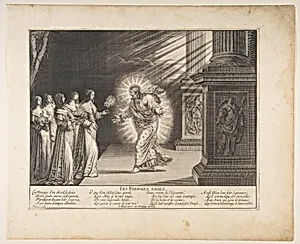
The Wise Virgins before Christ
ca. 1635
Medium
Etching and engraving
Dimensions
Sheet: 13 in. × 15 7/8 in. (33 × 40.3 cm) Plate: 10 1/16 × 12 13/16 in. (25.5 × 32.6 cm)
Classification
Prints
Department
Drawings and Prints
Museum
Metropolitan Museum of Art, New York, NY
Credit
Harris Brisbane Dick Fund, 1926
Accession Number
26.49.10
Rights
Public Domain
Tags
Art Historical Context
Created around 1635 by Abraham Bosse in collaboration with publisher Jean I Leblond, *The Wise Virgins before Christ* is a fine example of French printmaking during the early Baroque period. Executed in etching and engraving, the work measures just over ten by twelve inches in the plate, allowing for intricate detail while remaining suitable for wide distribution. Bosse, celebrated for his precise line work and narrative clarity, often explored moral and religious themes that resonated with both aristocratic and middle-class audiences of the time. The subject draws from the biblical Parable of the Ten Virgins in the Gospel of Matthew, focusing on the wise virgins who, with their lamps prepared, are welcomed by Christ. The presence of the Virgin Mary among the figures underscores themes of spiritual readiness and divine grace. Such imagery served an important devotional function in 17th-century France, where prints helped spread religious stories beyond the walls of churches. As a print rather than a painting, this work highlights the growing cultural importance of reproductive media. Affordable and portable, etchings and engravings like this one allowed broader audiences to engage with sacred narratives, blending artistic skill with the era’s expanding print culture.
About the Artist
Abraham Bosse|Jean I Leblond · 1602–1676
Abraham Bosse (1604–1676) was a French printmaker and theorist whose approximately 1,600 etchings provide an unparalleled visual record of 17th-century French life. Born to Huguenot parents in Tours, he trained in Paris under Melchior Tavernier and became a devoted follower of Jacques Callot's technical innovations. Bosse's meticulous etchings depicted subjects ranging from daily life and fashion ...