
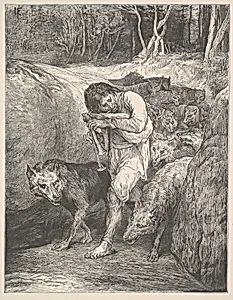
The Wolf-Charmer
Medium
Wood engraving
Dimensions
image: 6 15/16 x 5 3/8 in. (17.6 x 13.6 cm) sheet: 12 x 9 1/2 in. (30.5 x 24.2 cm)
Classification
Prints
Department
Drawings and Prints
Museum
Metropolitan Museum of Art, New York, NY
Credit
Rogers Fund, 1921
Accession Number
21.65.2
Rights
Public Domain
Tags
Art Historical Context
Created in 1867, *The Wolf-Charmer* is a striking wood engraving that captures a mysterious encounter between a human musician and wild animals. Designed by John La Farge, a leading figure in American art known for his luminous paintings and stained-glass innovations, and engraved by Henry Marsh, the print showcases the collaborative nature of 19th-century illustration. The scene, featuring a central figure with a musical instrument surrounded by attentive wolves, evokes themes of harmony between humanity and nature. Wood engraving was a dominant medium during this period, prized for its ability to produce fine detail and dramatic contrasts in black and white. This technique allowed artists to reach wide audiences through books and periodicals, bridging fine art and popular culture. La Farge’s design likely draws on literary or folkloric traditions, using the interplay of light and shadow to heighten the magical atmosphere. Housed in the Metropolitan Museum of Art’s Department of Drawings and Prints, this work reflects the era’s growing interest in narrative imagery and the technical mastery of American printmakers. Its modest size belies the intricate craftsmanship that rewards close viewing.
About the Artist
John La Farge|Henry Marsh · 1835–1910
John La Farge (1835–1910) was born into a wealthy French émigré family in New York City, the son of John Frederick La Farge and Louisa Binsse de Saint-Victor. Educated at Jesuit institutions including Mount St. Mary's College in Maryland and St. John's College (now Fordham University), he initially pursued law but turned to art after receiving early drawing lessons from his maternal grandfather, a...