
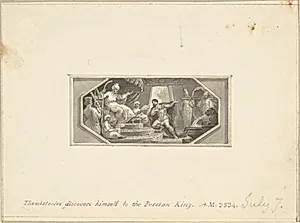
Themistocles Discovers Himself to the Persian King
1790–1800
Medium
Pen and brown ink, brush and gray wash
Dimensions
Sheet: 3 1/4 × 4 3/8 in. (8.3 × 11.1 cm)
Classification
Drawings
Department
Drawings and Prints
Museum
Metropolitan Museum of Art, New York, NY
Credit
Gift of Spencer Bickerton, 1933
Accession Number
33.69.16
Rights
Public Domain
Tags
Art Historical Context
In the late 18th century, artist Edward Francis Burney captured a pivotal moment from ancient history in *Themistocles Discovers Himself the Persian King* (1790–1800). This intimate drawing, executed in pen and brown ink with brush and gray wash, just 3¼ × 4⅜ inches, suggesting it was likely a preparatory study or collector's sketch. Burney, part of the illustrious Burney family of artists and writers, was known for his neoclassical illustrations and history scenes, blending dramatic narrative with refined line work. The subject draws from Plutarch's *Lives*, depicting the Greek hero Themistocles—victor at the Battle of Salamis—revealing his identity to the Persian king Artaxerxes I after exile from Athens. Ostracized for his ambitions, Themistocles sought refuge in Persia, offering his strategic genius to his former enemy. This scene symbolizes themes of fate, loyalty, and cultural collision between Greece and the East, resonating in an era fascinated by classical antiquity amid the Enlightenment. Burney's technique shines in the subtle gray washes that model figures and evoke depth on the small sheet, a hallmark of British draftsmanship. Housed in the Metropolitan Museum of Art's Drawings and Prints department (gift of Spencer Bickerton, 1933), it invites visitors to appreciate how such modest works preserve grand historical drama.
About the Artist
Edward Francis Burney · 1760–1848
Comment on works: Portraits, history