
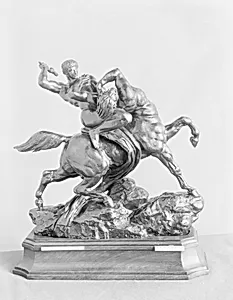
Theseus and the Centaur Bianor
modeled between 1846 and 1848
Medium
Bronze
Dimensions
Height: 13 1/4 in. (33.7 cm)
Classification
Sculpture-Bronze
Culture
French
Department
European Sculpture and Decorative Arts
Museum
Metropolitan Museum of Art, New York, NY
Credit
Rogers Fund, 1910
Accession Number
10.133.4
Rights
Public Domain
Tags
Art Historical Context
In the heart of Greek mythology, Theseus, the heroic slayer of the Minotaur, confronts the savage centaur Bianor in dynamic bronze sculpture by Antoine-Louisarye. Modeled between 1846 and 1848, the work captures a pivotal moment from the Centauromachy—the epic battle between the Lapiths and centaurs at wedding of Pirithous Hippodame. Barye, a leading French sculptor of the Romantic era and pioneer of the *animalier* style, masterfully blends human anatomy with equine ferocity, emphasizing raw power and tension. At just 13¼ inches tall, this bronze exemplifies Barye's revolutionary approach to sculpture. Renowned for his meticulous study of live animals at Paris zoos, he infused his works with lifelike musculature and movement, achieved through lost-wax casting techniques that allowed intricate details like straining veins and twisting forms. This piece, acquired via the Rogers Fund in 1910, highlights 19th-century fascination with classical myths amid France's industrial bronze boom. Housed in the Metropolitan Museum of Art's European Sculpture and Decorative Arts department, *Theseus and the Centaur Bianor* invites visitors to ponder heroism's primal edge, bridging ancient legend with modern realism in a compact yet monumental form.
About the Artist
Antoine-Louis Barye · 1795–1875
Antoine-Louis Barye (1795–1875) was born in Paris on September 24, the son of goldsmith Pierre Barye and Marguerite Barye. Following family tradition, he apprenticed as a goldsmith under his father and, around 1810, with Martin-Guillaume Biennais, goldsmith to Napoleon. After brief military service, Barye pursued sculpture, studying under François-Joseph Bosio in 1816 and painter Baron Antoine-Jea...