
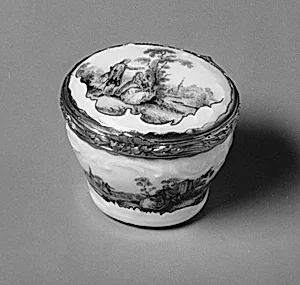
Thimble case
ca. 1760
Medium
Hard-paste porcelain, gold
Dimensions
Width: 1 5/16 in. (3.3 cm)
Classification
Ceramics-Porcelain
Culture
German, Meissen
Department
European Sculpture and Decorative Arts
Museum
Metropolitan Museum of Art, New York, NY
Credit
The Jack and Belle Linsky Collection, 1982
Accession Number
1982.60.351
Rights
Public Domain
Tags
Art Historical Context
Nestled in the Metropolitan Museum of Art's European and Decorative Arts collection this delicate thimble case from Meissen Manufactory circa 1760, the zenith of German porcelain craftsmanship. Measuring a mere 1 5/16 inches wide it is fashioned from hard-paste porcelain—a breakthrough material Meissen perfected as Europe's first producer in 1710—and enriched with gleaming gold accents. Part of The Jack and Belle Linsky Collection (2), it served as a luxurious holder for sewing thimbles, blending everyday utility with aristocratic elegance. Meissen's innovations in hard-paste porcelain allowed for translucent, durable forms rivaling Chinese imports, enabling intricate modeling and polychrome enameling. By the 1760s, amid the Rococo era's love for playful ornamentation, such tiny objects often featured finely painted scenes, possibly alluding to the "Men" tag with figural motifs of gentlemen or domestic vignettes. This reflects the manufactory's role in elevating decorative arts, where technical precision met artistic whimsy. A testament to 18th-century opulence, the thimble case highlights how Meissen porcelain democratized luxury, adorning bourgeois homes while symbolizing Saxony's industrial prowess. Visitors will appreciate its whimsical scale—a world in miniature that invites closer inspection.
About the Artist
Meissen Manufactory · 1710–present
The Meissen Manufactory, established on June 6, 1710, by Augustus the Strong, Elector of Saxony and King of Poland, marked the dawn of true hard-paste porcelain production in Europe. Nestled at Albrechtsburg Castle in Meissen near Dresden, the Royal Polish and Electoral Saxon Porcelain Manufactory arose from alchemical experiments begun in 1708 by physicist Ehrenfried Walther von Tschirnhaus and p...