
Thirius de Pautrizel
June or July 1795
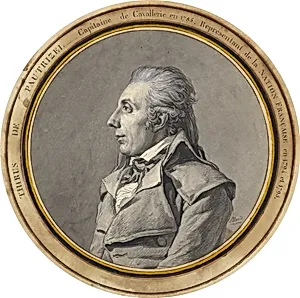
Medium
pen and gray ink with gray wash and pale brown wash (on the face) over touches of graphite, heightened with white gouache on laid paper, laid down on an old circular mount
Dimensions
overall (diameter): 19.2 cm (7 9/16 in.)
Classification
Drawing
Department
CG-E
Museum
National Gallery of Art, Washington, D.C.
Credit
Gift of Walter H. and Leonore Annenberg, in Honor of the 50th Anniversary of the National Gallery of Art
Accession Number
1990.47.2
Rights
Public Domain
Art Historical Context
Jacques-Louis David's *Thirius de Pautrizel* (June or July 179) is a captivating preparatory drawing that captures the Neoclassical master's precision during a turbulent period in French history. shortly after David's release from prison following the Reign of Terror, this intimate portrait likely depicts a contemporary figure, rendered in a circular format that evokes classical medallions. As a leading exponent of Neoclassicism, David clarity, realism, and moral virtue in his works, and this piece reflects his skill in translating revolutionary ideals into personal likenesses. The drawing's mixed media—pen and gray ink with gray and pale brown washes over graphite, heightened with white gouache on laid paper—demonstrates David's virtuoso technique. The washes add subtle tonal depth, while gouache highlights on the face create luminous modeling, mimicking the effects of oil painting. Laid down on an old circular mount, its 19.2 cm diameter (about 7½ inches) suggests it was a study for a larger work or a standalone gem, showcasing the portability and immediacy of 18th-century draftsmanship. Housed in the National Gallery of Art (gift of Walter H. and Leonore Annenberg for its 50th anniversary), this drawing offers a window into David's post-Revolutionary output, blending technical innovation with historical resonance. Visitors will appreciate its delicate balance of shadow and light, a testament to why David remains a pillar of Western art.
About the Artist
Jacques-Louis David · 1748–1825
Jacques-Louis David, born on August 30, 1748, in Paris, emerged as the preeminent French painter of Neoclassicism, a movement emphasizing austere lines, moral clarity, and classical antiquity as antidotes to Rococo frivolity. Orphaned young after his father's death in a duel, he was raised by prosperous architect uncles and educated at the Collège des Quatre-Nations. Defying family expectations, D...