
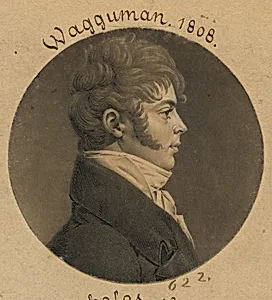
Thomas Ennalls Waggaman
Medium
Classification
Department
Smithsonian Collection
Museum
Smithsonian American Art Museum
Credit
National Portrait Gallery, Smithsonian Institution; gift of Mr. and Mrs. Paul Mellon
Accession Number
S/NPG.74.39.14.5
Rights
Public Domain
Tags
Art Historical Context
**Thomas Ennalls Wagg** (1808) is a refined profile portrait print by Charles Balthazar Julien Fret de Saint-Mé (1770–1852), a French artist who brought innovative techniques to early American portraiture. Created during the formative years of the young United States, this work captures the subject—a prominent male figure—in a classic silhouette style, emblematic of the era's fascination with physiognomy and personal identity. Saint-Mémin who emigrated from revolutionary France, pioneered the use of the *physionotrace*, a mechanical tracing device that produced precise profile outlines. These were then expertly engraved in stipple and often hand-colored, yielding affordable, miniature-like prints that democratized portraiture for the emerging American elite. His methodical approach blended Enlightenment science with artistry, resulting in over 800 such portraits that document key figures from 1795 to around 1810. Now part of the Smithsonian American Art Museum's collection—gifted by Mr. and Mrs. Paul Mellon—this print highlights the cultural role of visual records in building national identity. It invites us to ponder the poised gaze of Thomas Ennalls Waggaman against the backdrop of a nation in flux.