
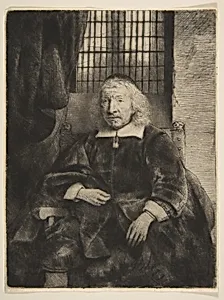
Thomas Haaringh (Old Haaringh)
Medium
Drypoint and burin; third of three states
Dimensions
sheet: 7 13/16 x 5 15/16 in. (19.8 x 15.1 cm)
Classification
Prints
Department
Drawings and Prints
Museum
Metropolitan Museum of Art, New York, NY
Credit
H. O. Havemeyer Collection, Bequest of Mrs. H. O. Havemeyer, 1929
Accession Number
29.107.23
Rights
Public Domain
Tags
Art Historical Context
This intimate portrait captures Thomas Haaringh, a respected bailiff and auctioneer in 17th-century Amsterdam, rendered by Rembrandt van Rijn around 1655. As one of the Dutch master’s later prints, it reflects his deep interest in character and human presence during a period when he faced personal and financial challenges. The sitter’s direct gaze and dignified bearing convey quiet authority, inviting viewers to consider the personal connections Rembrandt often explored in his work. Executed in drypoint and burin on copper, the print showcases Rembrandt’s innovative approach to the medium. Drypoint creates soft, velvety lines from the burr of metal raised during scratching, while the burin adds precise definition. This impression represents the third of three states, showing how the artist refined the image through successive reworking to achieve greater depth and texture. Such technical mastery helped elevate printmaking to an expressive art form equal to painting or drawing. Housed in the Metropolitan Museum of Art’s collection through the generosity of the Havemeyer family, this small sheet (roughly 8 by 6 inches) exemplifies Rembrandt’s enduring influence on portraiture and graphic arts. It offers a window into both individual lives and the vibrant cultural world of the Dutch Golden Age.
About the Artist
Rembrandt (Rembrandt van Rijn)|Thomas Haaringh · 1606–1669
Rembrandt Harmenszoon van Rijn (1606–1669) stands as one of the greatest visual artists in the history of Western art and the most important Dutch painter of the 17th century. Born in Leiden to a prosperous miller's family, Rembrandt transformed painting through his revolutionary use of light and shadow, his psychological depth in portraiture, and his elevation of etching to a fine art. His approx...