
Thomas Scott
Medium
engraving
Dimensions
sheet: 16 × 11.7 cm (6 5/16 × 4 5/8 in.)
Classification
Department
CG-E
Museum
National Gallery of Art, Washington, D.C.
Credit
Rosenwald Collection
Accession Number
1951.11.19
Rights
Public Domain
Art Historical Context
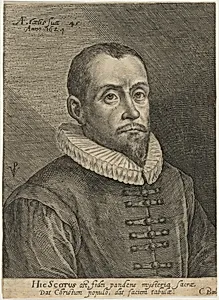
This delicate engraving by Crispijn de I captures Thomas Scott in1624, offering a glimpse into early seventeenth-century portraiture. De Passe, a Dutch engraver renowned for his precise line work, created many such prints that circulated widely across Europe. Measuring just 16 by 11.7 centimeters, the small sheet was likely intended for inclusion in books or private collections rather than display on a wall. Engraving allowed artists to reproduce fine details with remarkable clarity, making portraits of notable figures accessible to a broader audience. In an era before photography, these prints served as important records of identity and status. De Passe’s technique—employing fine parallel lines and subtle shading—gives the image both depth and a sense of immediacy despite its modest size. Created during the Dutch Golden Age, the work reflects the growing demand for affordable images of political and religious figures. Now part of the National Gallery of Art’s Rosenwald Collection, it stands as a fine example of how printmaking helped shape public memory in the seventeenth century.
About the Artist
Crispijn de Passe I
Crispijn de Passe I, born around 1564 in Arnemuiden, Zeeland, emerged as one of the most influential Dutch engravers and print publishers of his era. He relocated to Antwerp as a youth, where he honed his craft amid the city's vibrant printmaking scene, becoming an independent master in the Guild of Saint Luke by 1584–1585. There, he worked as a reproductive engraver, primarily after designs by pr...