
Thornton
Medium
Albumen silver print from paper negative
Dimensions
Image: 21.4 x 26.9 cm (8 7/16 x 10 9/16 in.) Mount: 32.5 x 37.9 cm (12 13/16 x 14 15/16 in.)
Classification
Photographs
Department
Photographs
Museum
Metropolitan Museum of Art, New York, NY
Credit
Gift of Paul F. Walter, 2009
Accession Number
2009.460.3
Rights
Public Domain
Tags
Art Historical Context
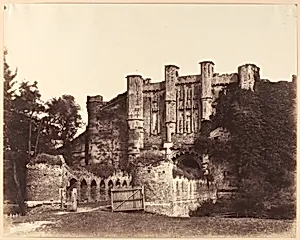
Alfred Capel Cure's *Thornton* (1860) captures the evocative ruins of Thornton Abbey in Lincolnshire, England—a once-grand Cistercian monastery founded in the 12th century. This albumen silver print from a negative exemplifies the mid-19th-century fascination with Gothic architecture and picturesque decay, a romantic ideal that blended historical reverence with the sublime beauty of nature reclaiming human works. Cure, a British army officer and pioneering amateur photographer, documented such sites with a keen eye for light and texture, preserving vanishing medieval heritage amid the Industrial Revolution's rapid changes. The albumen process, introduced in the 1850s, was revolutionary for its sharp detail and rich tonal range, achieved by coating paper with egg whites (albumen) sensitized with silver salts. Printed from a paper negative—a less common choice than glass for its portability—Cure's 21.4 x 26.9 cm image reveals intricate stone tracery and weathered arches, inviting viewers to ponder time's passage. Housed in the Metropolitan Museum of Art as a gift from Paul F. Walter in 2009, this photograph bridges early photography's technical innovation with enduring cultural appreciation for Britain's architectural past.
About the Artist
Alfred Capel Cure · 1826–1896
Alfred Capel Cure (1826–1896) was a British artist whose career unfolded during the Victorian era, a period of remarkable diversity and ambition in British art. Active in a landscape tradition shaped by the achievements of John Constable and J.M.W. Turner, Cure worked at a time when watercolor and drawing held an especially prominent place in English artistic culture, embraced both by professional...