
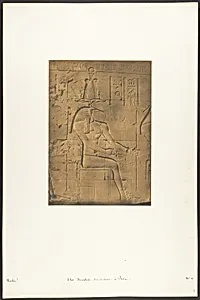
Thot Ibiocéphale (Dieu des Lettres) à Philae
April 1850
Medium
Salted paper print from paper negative
Dimensions
Image: 9 1/8 × 6 1/2 in. (23.2 × 16.5 cm) Mount: 12 5/16 × 18 11/16 in. (31.2 × 47.5 cm)
Classification
Photographs
Department
Photographs
Museum
Metropolitan Museum of Art, New York, NY
Credit
Gilman Collection, Gift of The Howard Gilman Foundation, 2005
Accession Number
2005.100.376.117
Rights
Public Domain
Tags
Art Historical Context
In the spring of 1850, French writer and pioneering photographer Maxime Du Camp captured *Thot Ibiocéphale (Dieu desres) à Philae*, a salted paper print from a paper that immortalizes an ancient Egyptian relief at the Temple of Philae. This striking image depicts Thoth, the ibis god of wisdom, writing, and the moon—known as the "God of Letters" for his role in inventing hieroglyphs and recording divine judgments. The photograph's intimate scale (9 1/8 × 6 1/2 in.) draws viewers into the intricate carvings, where Thoth's elongated beak and poised scribal stance evoke the sacred mysteries of pharaonic Egypt. Du Camp took this photograph during his transformative 1849–1850 journey through Egypt and the Near East alongside Gustave Flaubert, producing one of the earliest comprehensive photographic documentations of ancient monuments. Published in his landmark album *Egypt, Nubie, Palestine et Syrie* (1852), the image exemplifies the calotype process—William Henry Fox Talbot's invention using paper negatives for multiple prints—valued for its soft tonal range and artistic detail over the sharper glass-plate daguerreotypes. Today, housed in The Metropolitan Museum of Art's Gilman Collection, this print bridges 19th-century exploration with timeless cultural heritage. It not only preserves a hieroglyph-adorned relic from Ptolemaic times but also highlights photography's power to democratize access to the wonders of antiquity, inviting modern visitors to ponder Thoth's enduring legacy as patron of knowledge.
About the Artist
Maxime Du Camp · 1822–present
Maxime Du Camp (1822–1894) was a pioneering French photographer and writer whose adventurous spirit and technical innovation bridged literature and visual art during the mid-19th century. Born in Paris on February 8, 1822, to a prosperous family—his father a successful surgeon—Du Camp received a solid bourgeois education at the Collège Bourbon (now Lycée Condorcet), where he cultivated interests i...