
Three Bathers I (Les trois baigneuses I)
1922/1923
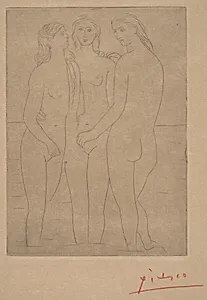
Medium
drypoint (zinc)
Classification
Department
CG-W
Museum
National Gallery of Art, Washington, D.C.
Credit
Rosenwald Collection
Accession Number
1964.8.1391
Rights
Public Domain
Art Historical Context
In the serene world of Pablo Picasso's *Three Bathers I (Les trois baigneuses)*, created between 1922 and 1923, we encounter three graceful female figures bathed in a classical reverie. This drypoint print on zinc captures the artist's pivot toward Neoclassicism, a deliberate return to figurative harmony after the angular disruptions of Cubism. Picasso, ever the innovator, drew inspiration from antiquity and masters like Ingres, rendering elongated forms and poised bathers that evoke timeless myths of leisure and nature. The medium of drypoint is key to its allure: Picasso scratched directly into the zinc plate with a sharp tool, producing burrs that yield rich, velvety lines full of texture and spontaneity—far softer than etched lines. This intimate technique allowed Picasso to explore line's poetic potential in small-scale prints, making high art accessible. Part of the distinguished Rosenwald Collection at the National Gallery of Art, this work exemplifies Picasso's printmaking prowess during his neoclassical phase, blending modern genius with eternal beauty. (178 words)
About the Artist
Pablo Picasso · 1881–1973
Pablo Picasso (1881–1973), born Pablo Diego José Francisco de Paula Juan Nepomuceno María de los Remedios Cipriano de la Santísima Trinidad Ruiz y Picasso in Málaga, Spain, was the son of José Ruiz Blasco, a painter and art professor who served as his first teacher. From age seven, Picasso trained under his father in figure drawing and oil painting, mastering naturalistic techniques by copying mas...