
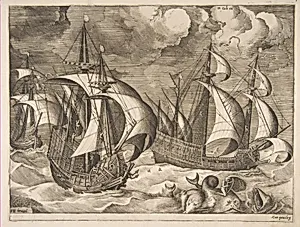
Three Caravels in a Rising Squall with Arion on a Dolphin from The Sailing Vessels
Medium
Engraving; first state of six
Dimensions
sheet: 10 1/4 x 21 3/16 in. (26.1 x 53.8 cm)
Classification
Prints
Department
Drawings and Prints
Museum
Metropolitan Museum of Art, New York, NY
Credit
Harris Brisbane Dick Fund, 1928
Accession Number
28.4(6)
Rights
Public Domain
Tags
Art Historical Context
This engraving, designed by Pieter Bruegel the Elder and executed by Huys for publisher Hieronymus Cock around 1561–65, captures a dramatic maritime scene from the series *The Sailing Vessels*. Bruegel, renowned for his masterful depictions of nature and human activity during the Northern Renaissance, brings his keen eye for atmospheric detail to this print. The work shows three caravels— nimble sailing ships emblematic of the Age of Exploration—battling a rising squall, their sails billowing against turbulent waves. At the center, the mythological poet Arion perches gracefully on a dolphin, clutching his lyre, a nod to the ancient tale of his rescue at sea. This fusion of contemporary naval imagery with classical myth highlights the era’s fascination with both seafaring adventure and humanist learning. As an engraving, the medium allowed Bruegel’s intricate compositions to reach wide audiences through reproductive prints, showcasing fine linework that conveys the texture of churning water and billowing fabric. Housed in the Metropolitan Museum of Art, this first-state impression underscores the collaborative nature of 16th-century printmaking and its role in disseminating artistic innovation across Europe.
About the Artist
Pieter Bruegel the Elder|Frans Huys|Hieronymus Cock · 1525–1569
Pieter Bruegel the Elder, a pioneering Netherlandish painter of the Renaissance, was born around 1525–1530, likely in Breda in the Duchy of Brabant (present-day Netherlands). Little is known of his early family background, but he apprenticed under the Antwerp painter and designer Pieter Coecke van Aelst between approximately 1545 and 1550, mastering tapestry design, architecture, and painting tech...