
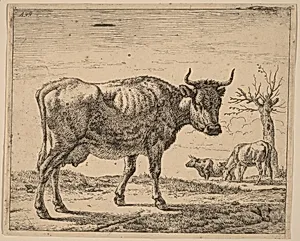
Three Cows
c. 1657/1659
Medium
etching
Classification
Department
CG-E
Museum
National Gallery of Art, Washington, D.C.
Credit
Rosenwald Collection
Accession Number
1943.3.8227
Rights
Public Domain
Art Historical Context
Adriaen van de Velde's *Three Cows* (c. 1657/1659) captures the quiet majesty of rural life during the Dutch Golden Age. This delicate etching, housed in the National Gallery of Art's Rosenwald Collection, showcases van de Velde's mastery as a young artist—barely in his early twenties—already renowned for his naturalistic depictions of animals and landscapes. As part of the Dutch Baroque tradition, his work reflects the era's fascination with pastoral harmony, evoking the prosperity and peaceful countryside of 17th-century Netherlands. Etching, van de Velde's chosen medium here, allowed for intricate lines and subtle tonal effects, biting acid into a metal plate to create rich, velvety textures. The three cows, likely rendered with meticulous anatomical detail, embody his skill in portraying livestock as noble subjects, blending realism with poetic grace. This print exemplifies how etchings democratized fine art, making van de Velde's studies accessible beyond oil paintings. A gem of the Print department (CG-E), *Three Cows* invites visitors to appreciate the artist's early brilliance and the enduring charm of Dutch animalier art.
About the Artist
Adriaen van de Velde · 1636–1672
Adriaen van de Velde (1636–1672) was a Dutch Golden Age painter, draftsman, and etcher renowned for his luminous pastoral landscapes and his extraordinary versatility. Born in Amsterdam, he was the son of the marine painter Willem van de Velde the Elder and brother of the marine painter Willem van de Velde the Younger. He studied under Jan Wijnants, a landscape specialist, and possibly under Phili...