
Three Designs for Candlesticks
ca. 1770–1816
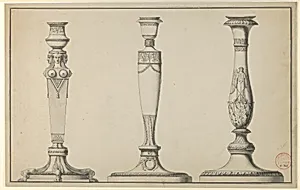
Medium
Pen and black ink, brush and gray wash, with framing lines in pen and black ink
Dimensions
13 3/8 x 21 1/8 in. (34 x 53.7 cm)
Classification
Drawings|Ornament & Architecture
Department
Drawings and Prints
Museum
Metropolitan Museum of Art, New York, NY
Credit
Purchase, Rogers Fund and The Elisha Whittelsey Collection, The Elisha Whittelsey Fund, 1978
Accession Number
1978.521.2
Rights
Public Domain
Tags
Art Historical Context
Henri Auguste’s *Three Designs for Candlest*, created around 1770–1816, offers a captivating glimpse into the opulent world of French decorative arts during the late Enlightenment and Napoleonic eras. As a skilled designer likely associated with Parisian workshops, Auguste specialized in ornamental silverwork and architecture, crafting intricate proposals for luxury household objects. These elegant candlestick designs reflect the neoclassical taste of the time, blending graceful curves with symmetrical motifs inspired by antiquity—perfect for illuminating the salons of the aristocracy or emerging elite. Rendered in pen and black ink with brush and gray wash, the sheet measures an impressive 13 3/8 x 21 1/8 inches, showcasing Auguste’s masterful technique. Precise ink lines delineate fine details like fluted columns and acanthus leaves, while subtle gray washes add depth and three-dimensionality, simulating the gleam of polished metal. This mixed-media approach was standard for presentation drawings, allowing goldsmiths to visualize and refine pieces before fabrication. Housed in the Metropolitan Museum of Art’s Drawings and Prints department, this work highlights the pivotal role of such sketches in bridging art and craft. Acquired in 1978 through prestigious funds, it underscores the enduring appeal of 18th-century design, where functionality met exquisite ornamentation in objects that lit both homes and history.
About the Artist
Henri Auguste · 1759–1816
**Henri Auguste (1759–1816)** was a leading Parisian gold- and silversmith renowned for his elegant neoclassical and Empire-style works in *orfèvrerie*. As the only son of the royal goldsmith Robert-Joseph Auguste (1723–1805), he assumed ownership of his father’s workshop in 1784–85 and carried forward the family tradition of refined, classically inspired silverware. Auguste collaborated closely ...